Are Fireworks Illegal in California? Here’s What You Actually Need to Know (2026)
Every Fourth of July in San Diego, it starts the same way. A few nights before the holiday, someone a few blocks over lights something that clearly flies, explodes, and rains sparks over a dry canyon. I grew up watching this and never fully understood which fireworks were actually legal and which could put someone in handcuffs.
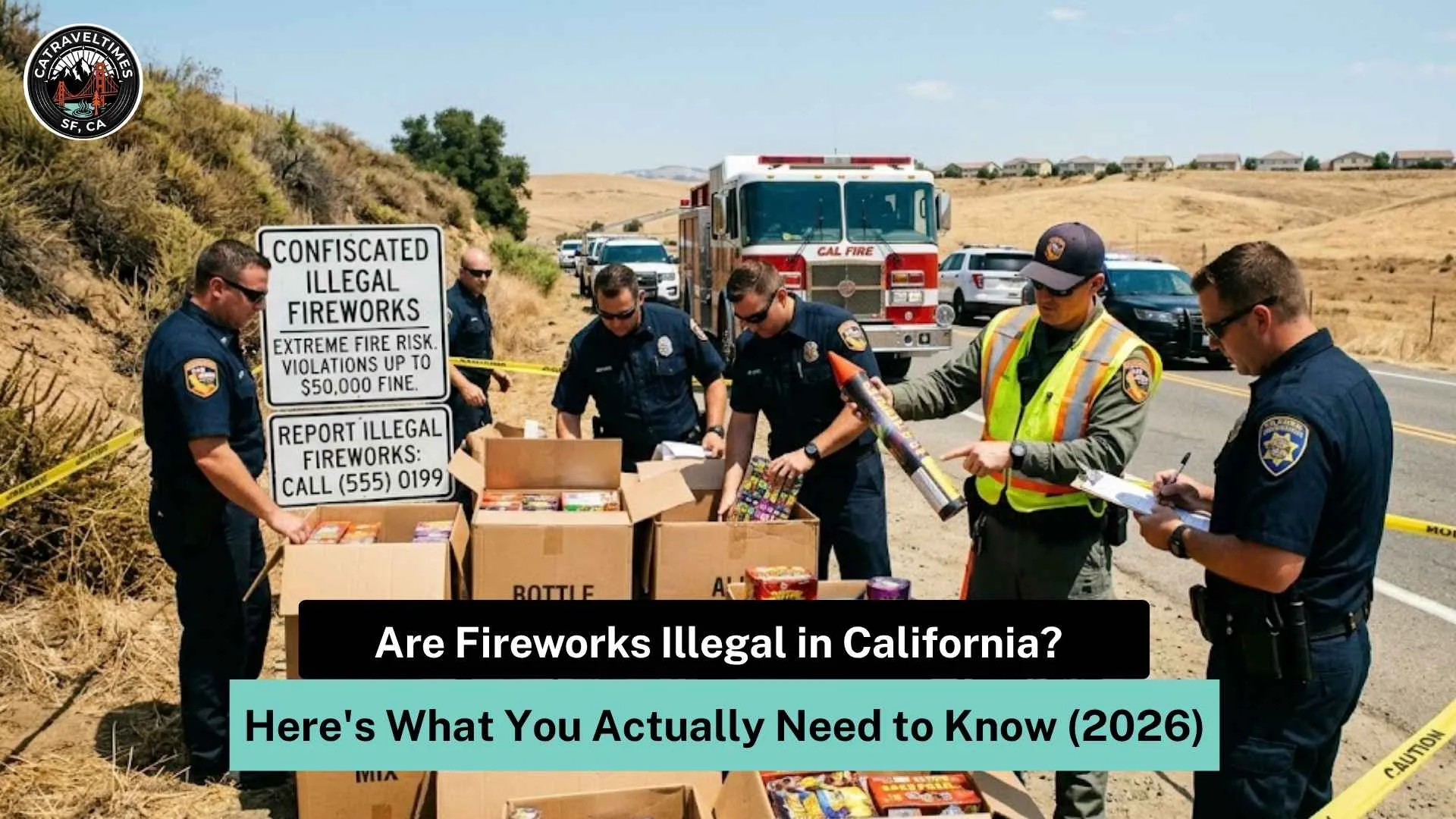
So are fireworks illegal in California? The honest answer: most of them are. California does not run a blanket statewide ban on every single firework — but the vast majority of what people associate with celebrations is completely off-limits. In 2026, more cities are moving toward total bans, enforcement is stricter than ever, and the fines are serious — up to $50,000.
I put this guide together for CA Travel Times so you know exactly where the lines are before you buy or light anything this summer.
What Does California Law Say About Fireworks?
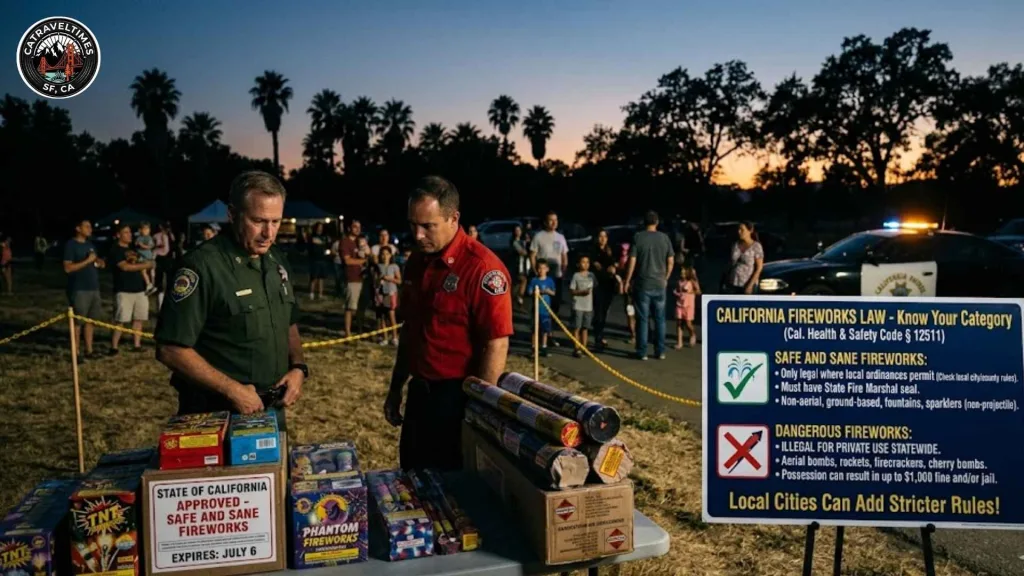
California fireworks are governed by the State Fireworks Law under Cal. Health & Safety Code § 12511. The law defines fireworks as any device containing chemical elements that burn without outside oxygen and produces visual, audible, mechanical, or thermal effects for entertainment. The law splits all fireworks into two categories — Safe and Sane (legal in some cities) and dangerous (illegal for private use statewide). Local cities can — and often do — add stricter rules on top of state law.
What Are Safe and Sane Fireworks in California?
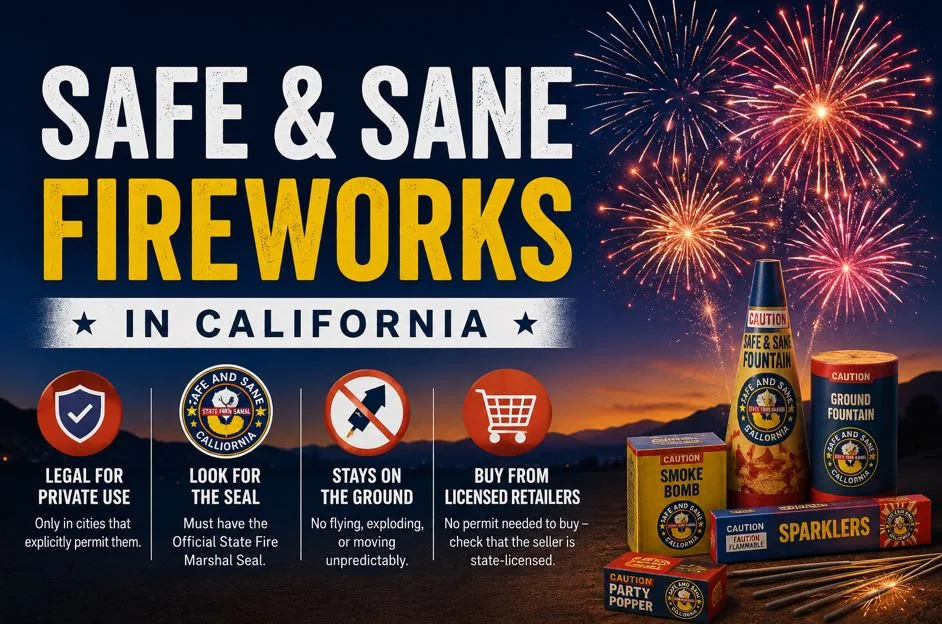
Safe and Sane fireworks are the only consumer fireworks legal for private use in California, and only in cities that explicitly permit them. The core rule: they cannot fly into the air, explode, or move unpredictably on the ground. Every permitted firework must carry the official Office of the State Fire Marshal seal. No seal means it is illegal — regardless of what the label says or where it was purchased.
What counts as Safe and Sane?
Items that typically qualify include ground-based fountains, small sparklers (under 10 inches long and under ¼ inch wide), party poppers, paper caps, and smoke bombs. Even here, size matters — oversized sparklers are reclassified as dangerous fireworks and become illegal immediately.
Do Safe and Sane fireworks need a permit to buy?
No permit is needed to purchase them as a consumer — but you must buy from a licensed retailer during the approved sale window. The seller, not the buyer, holds the retail license. Always check that the stand or store you buy from is state-licensed.
What Fireworks Are Illegal in California?
California has zero tolerance for illegal fireworks. Dangerous fireworks are completely off-limits for private citizens without a license or permit — no exceptions. According to the California Department of Forestry and Fire Protection (CAL FIRE) and the Office of the State Fire Marshal, the following are all classified as dangerous fireworks and are illegal to possess, sell, or use:
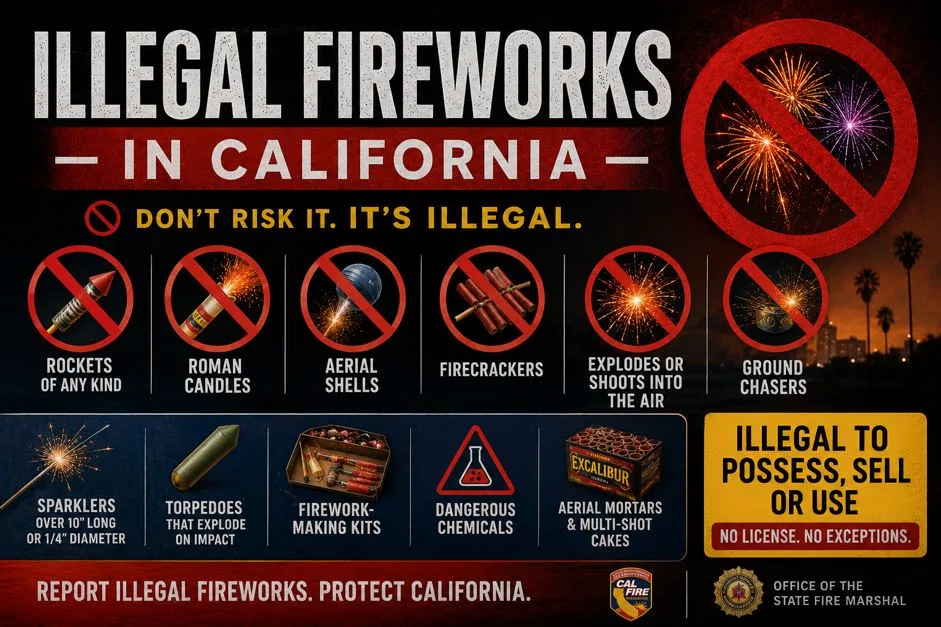
- Sky rockets and bottle rockets
- Roman candles
- Aerial shells
- Firecrackers
- Anything that shoots into the air
- Anything that explodes on discharge
- Chasers — anything that darts or travels along the ground in an uncontrolled manner
- Sparklers over 10 inches long or over 1/4 inch in diameter
- Torpedoes that explode on impact
- Firework-making kits
- Any fireworks designated as unsafe by the State Fire Marshal
Fireworks containing arsenic sulfide, arsenates, boron, chlorates (with limited exceptions), magnesium, mercury salts, phosphorus, picrates, thiocyanates, titanium, or zirconium are also illegal — regardless of appearance or packaging.
Products like Excalibur fireworks — which include aerial mortars and multi-shot cakes — are illegal for private use in California. No matter how widely available they are in neighboring states, bringing or using them here puts you at serious legal risk.
Are Fireworks Illegal Everywhere in California?
Not technically — but in most of the state, yes. Around 300 California communities allow Safe and Sane fireworks under local rules. Every other city and county defaults to a complete ban. As of 2026, that number is shrinking — more municipalities are opting for full bans as wildfire risk grows each season.
Even in cities that allow Safe and Sane fireworks, there are strict location and time restrictions. The blanket assumption that fireworks are fine in your backyard is wrong in most of California.
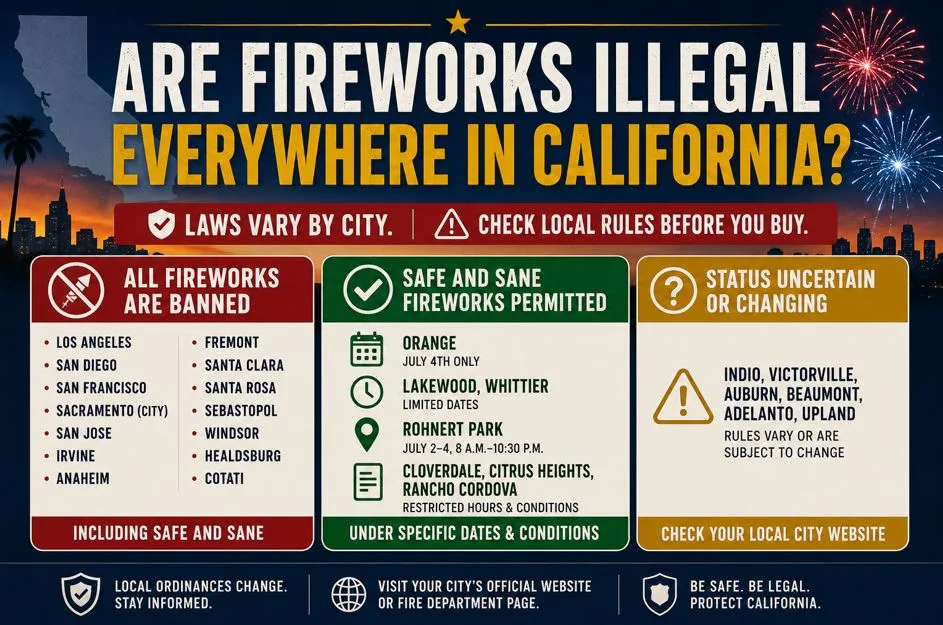
Cities where ALL fireworks are banned
These major California cities ban every type of firework — including Safe and Sane:
| City | Status |
| Los Angeles | All fireworks banned |
| San Diego | All fireworks banned |
| San Francisco | All fireworks banned |
| Sacramento (City) | All fireworks banned |
| San Jose | All fireworks banned |
| Irvine | All fireworks banned |
| Anaheim | All fireworks banned |
| Fremont | All fireworks banned (since 1986) |
| Santa Clara | All fireworks banned |
| Santa Rosa | All fireworks banned |
| Sebastopol | All fireworks banned |
| Windsor | All fireworks banned |
| Healdsburg | All fireworks banned |
| Cotati | All fireworks banned |
Cities where Safe and Sane fireworks are permitted
These cities allow Safe and Sane fireworks under specific dates and conditions:
| City | Notes |
| Orange | July 4th only, noon–10 p.m., residential areas only |
| Lakewood | Limited dates; check current local ordinance |
| Whittier | Limited dates; check current local ordinance |
| Rohnert Park | July 2–4, 8 a.m.–10:30 p.m.; $1,000 fine for illegal fireworks |
| Cloverdale | State-approved fireworks permitted within city limits |
| Citrus Heights | Safe and Sane with restricted hours; unincorporated ban |
| Rancho Cordova | Safe and Sane with time restrictions |
Cities where status is uncertain or changing
Cities like Indio, Victorville, Auburn, Beaumont, Adelanto, and Upland have rules that vary or are subject to change. Check your city’s official website or fire department page before purchasing anything. The California Local Guides section covers many of these cities in detail.
When Are Fireworks Legal to Buy and Use in California?
Even where fireworks are allowed, the sale window is narrow. Licensed retailers may only sell Safe and Sane fireworks from noon on June 28 through noon on July 6 each year. Retailer licenses expire automatically at noon on July 6 and must be renewed by June 15 annually.
Permitted use hours vary by city
In Orange, use is limited to July 4th between noon and 10 p.m. In Rohnert Park, use is permitted July 2–4 from 8 a.m. to 10:30 p.m. Every city sets its own window — and using fireworks outside that window, even Safe and Sane ones, is a violation.
Where exactly can you use them — even in permitted cities?
Location restrictions apply inside permitted cities too. You generally cannot discharge fireworks on public streets, parks, sidewalks, in commercial or industrial zones, within 10 feet of any structure, within 300 feet of a fireworks stand, or within 100 feet of any gas station or flammable liquid storage.
What Are the Penalties for Illegal Fireworks in California?
California’s penalties are not a slap on the wrist. California Penal Code Section 12677 and related sections of the Health & Safety Code outline consequences that escalate sharply based on how much you’re caught with:
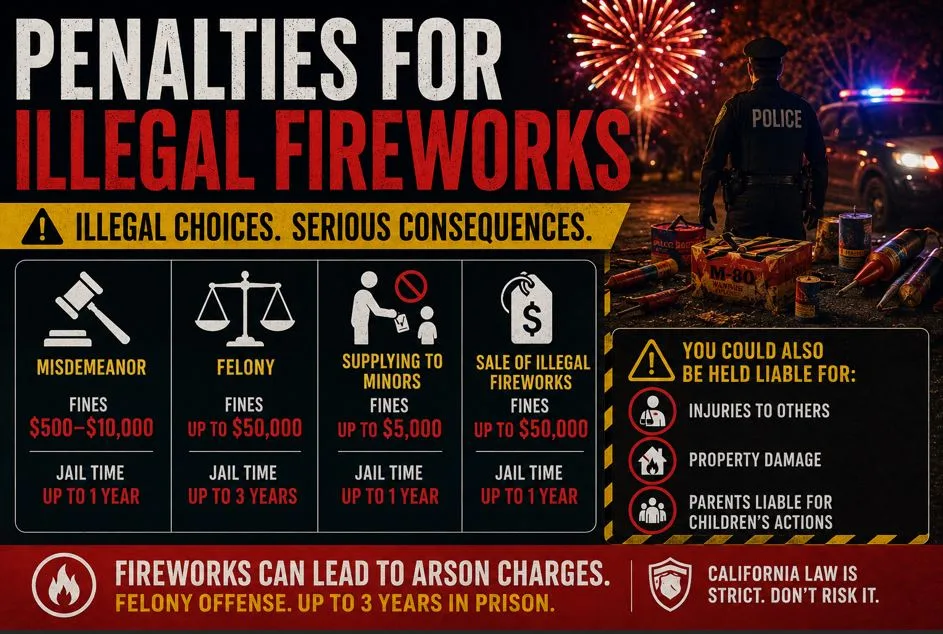
| Offense | Classification | Fine | Jail |
| Possessing or using dangerous fireworks (1st offense) | Misdemeanor | $500–$1,000 | Up to 1 year |
| Possessing or using dangerous fireworks (2nd offense) | Misdemeanor | $1,000 minimum | Up to 1 year |
| Possession of 25–100 lbs of dangerous fireworks | Misdemeanor | $1,000–$5,000 | Up to 1 year |
| Possession of 100+ lbs of dangerous fireworks | Misdemeanor or Felony | Up to $10,000 | Up to 3 years |
| Possession of 5,000+ lbs | Felony | Up to $50,000 | Up to 3 years |
| Supplying dangerous fireworks to minors (1st offense) | Misdemeanor | $500–$1,000 | Up to 1 year |
| Supplying dangerous fireworks to minors (2nd offense) | Misdemeanor (no probation) | $5,000 | Up to 1 year |
| Sale of illegal fireworks | Misdemeanor | Up to $50,000 | Up to 1 year |
Beyond fines and jail time, there is a risk many people miss entirely: if you host a gathering where fireworks injure a guest or damage property, you can be held personally liable. Parents are also legally responsible for fireworks injuries caused by their children under state law.
In more serious cases, fireworks that start a fire can lead to arson charges under California Penal Code Section 451 — a felony. CAL FIRE and local fire agencies have filed arson charges in situations where fireworks sparked wildfires on dry land. This is not a theoretical risk in a state that experiences devastating fires throughout the year.
Can You Buy Fireworks in Another State and Bring Them Into California?
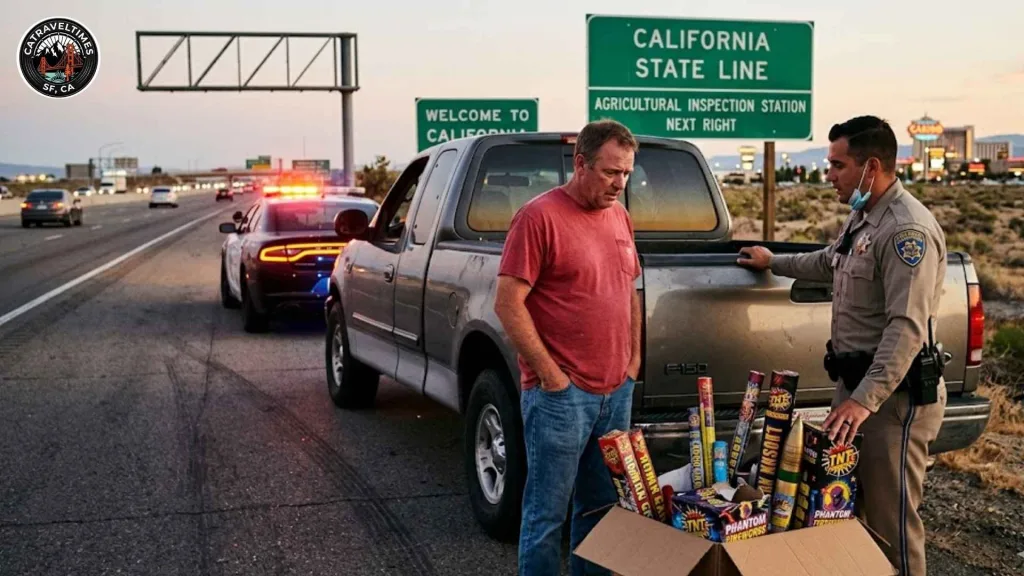
No. Federal law makes it illegal to transport fireworks across state lines into a state where those fireworks are prohibited. Violations carry up to one year in prison and a monetary fine (18 U.S.C. § 836).
If you cross into California with fireworks that are illegal here — even if you bought them legally in Nevada, Arizona, or Oregon — you can face federal charges for transporting them and California charges for possessing them. This is one of the most common mistakes I see people make, especially near state borders around the Fourth of July.
Who Can Legally Use Dangerous Fireworks in California?
A narrow group of licensed professionals can legally use dangerous fireworks. The Office of the State Fire Marshal licenses pyrotechnic operators, fireworks manufacturers, importer-exporters, wholesalers, retailers, and public display companies through its Fireworks Program.
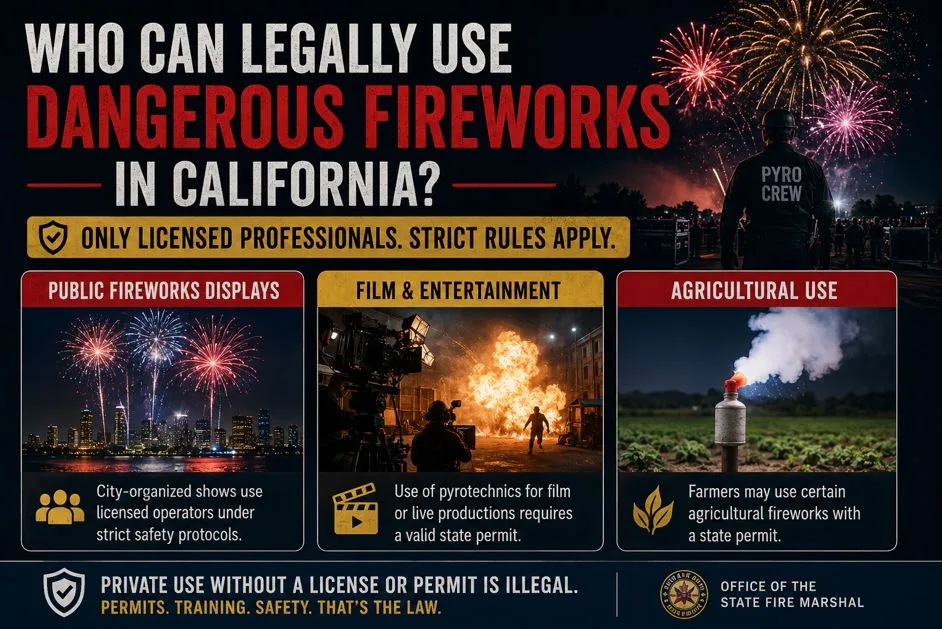
Public fireworks displays
City-organized Fourth of July shows use licensed operators who follow strict protocols. Dangerous fireworks are permitted at these events precisely because licensed professionals handle them under controlled conditions.
Film and entertainment productions
Film directors and production companies can use pyrotechnic devices for special effects — on set, on location, or before a live audience — but only with a valid state permit. This does not apply to private individuals.
Agricultural use
Farmers may use certain agricultural fireworks — typically noise-makers or flash pots — to scare birds or wildlife away from crops. A state permit is required. These are exempt fireworks with a specific, limited purpose and cannot be used recreationally.
How Is California Enforcing Fireworks Laws in 2025 and 2026?
Enforcement has intensified significantly. In 2025, California seized over 600,000 pounds of illegal fireworks — more than double the annual average over the previous decade, according to Governor Gavin Newsom’s office. Fireworks caused over $35 million in property damage and sparked 1,230 fires across California since 2024.
The California Highway Patrol ran a Holiday Enforcement Period from July 3 through July 6, 2025. During the 2024 Independence Day period, CHP officers made 1,336 DUI arrests — one every 17 minutes — and 29 people died in road crashes statewide.
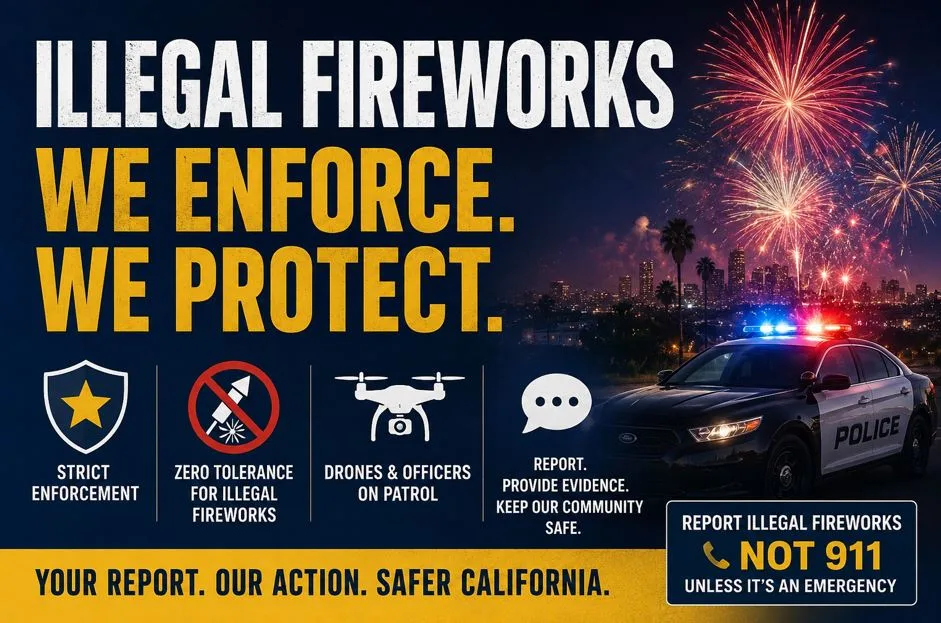
Going into 2026, CAL FIRE’s arson and bomb investigators are continuing joint enforcement operations with local and federal authorities. Sacramento has moved to enforce fireworks rules year-round, not just around the Fourth of July, and has adopted stricter local penalties. Cities across the state are adding civil penalties on top of criminal ones, meaning violators can face both a criminal fine and a separate administrative citation.
How do cities actually catch violators?
Officers must witness the violation directly, or a resident must sign an attestation — similar to a private person’s arrest — supported by photos or video evidence and a willingness to testify. Many cities also use drone support (UAS) within FAA line-of-sight rules during peak periods.
How to report illegal fireworks
Every city has slightly different reporting channels, but most accept:
- Non-emergency police line (with specific location, description, and evidence)
- City mobile apps (like Orange 24/7 in the City of Orange)
- Anonymous tip hotlines where available
Calling 911 is appropriate only if there is an immediate fire or safety emergency — not for noise complaints about fireworks.
Why Are Fireworks Laws So Strict in California?
The answer is simple: California burns. Human activity accounts for roughly 95% of all wildfire starts in the state, and fireworks are a well-documented cause. In 2025, California recorded 8,036 wildfires burning over 525,000 acres, destroying more than 16,500 structures and killing at least 31 people.
California also reports the highest fireworks injury rate of any state — approximately 1,200 fireworks-related injuries annually, according to 2026 injury data. July 4th weekend alone accounts for roughly one-third of all annual fireworks ER visits nationally.
Dry vegetation, drought conditions, and dense housing make the combination of fireworks and summer heat uniquely dangerous here. The CalHeatScore tool and Listos California emergency alerts exist partly to flag these overlapping risks to residents before conditions peak.
Common Misconceptions About California Fireworks Laws
A lot of people make costly assumptions about what is and is not allowed. Here are the ones I see most often.
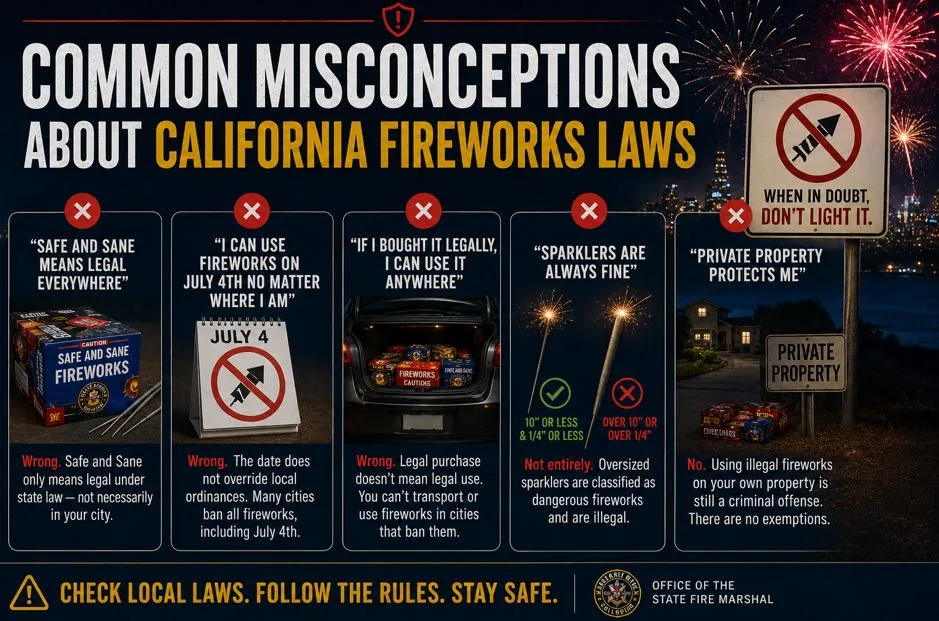
“Safe and Sane means legal everywhere”
Wrong. Safe and Sane only means legal under state law — not necessarily in your city. The majority of major California cities ban them entirely.
“I can use fireworks on July 4th no matter where I am”
Wrong. The date does not override local ordinances. In Los Angeles, San Diego, San Francisco, and dozens of other cities, July 4th is like any other day — all fireworks are still banned.
“If I bought it legally, I can use it anywhere”
Wrong. A firework purchased legally in another state or even in a California city that allows it cannot be transported to or used in a city that bans it.
“Sparklers are always fine”
Not entirely. Sparklers over 10 inches long or over ¼ inch in diameter are classified as dangerous fireworks and are illegal. Always check the dimensions before buying.
“Private property protects me”
No. Using illegal fireworks on your own property is still a criminal offense. Private property does not create a legal exemption.
Safe Fireworks Tips for Cities That Allow Them
If you are in one of the roughly 300 California communities that permit Safe and Sane fireworks, these are the rules to follow to stay legal and avoid accidents.
- Only use fireworks bearing the State Fire Marshal Safe and Sane seal
- Verify local ordinances before buying — rules change year to year
- Use fireworks outdoors only, away from dry grass, brush, or any flammable materials
- Always have an adult present; never let minors handle fireworks unsupervised
- Light one firework at a time and move back immediately after lighting
- Keep a bucket of water and a garden hose ready at all times
- Never use fireworks within 100 feet of a gas station or anywhere flammable liquids are stored
- Do not point or throw any firework toward another person
- Never re-light a failed firework — soak it in water and discard it
- Fully submerge all used fireworks in water before disposal, especially during dry conditions
Bottom Line
Are fireworks illegal in California? For the majority of the state in 2026, yes — the practical answer is do not use them unless you have confirmed your city explicitly allows it. Most of California’s largest cities ban all fireworks. The few hundred communities that do allow them impose tight restrictions on timing, location, and product type.
The legal risk is real: fines up to $50,000, up to a year in jail, and potential civil liability if someone gets hurt. The physical risk is just as serious — California reports roughly 1,200 fireworks injuries per year, and fireworks remain a leading cause of the wildfires that devastate communities across the state every summer.