
Does California Recognize Common Law Marriage? (2026 Guide)
A friend of mine in San Diego once told me she and her partner were “basically married” after eight years together, a shared mortgage, and joint bank accounts. She was genuinely surprised when I explained that California sees it differently.
If you’re in a long-term relationship in California and you’ve been wondering where you stand legally — this guide is for you. I’ve reviewed the California Family Code, cross-referenced 2026 legal resources, and organized everything you need to know in one place. You’ll also find more California lifestyle and legal guides at CA Travel Times.
What Is Common Law Marriage?
Common law marriage is a legal arrangement where two people are treated as married by a state — without a formal ceremony or marriage license — based on how long they’ve lived together and how they present themselves to others as a couple.
In states that recognize it, couples generally need to show three things:
- They lived together for a qualifying period
- They intended to be married to each other
- They held themselves out publicly as a married couple
No ceremony is required. No license is filed. The state simply treats the relationship as a legal marriage under the law.
Does California Recognize Common Law Marriage?
California does not recognize common law marriage — and this has been the case since 1895 when the state formally abolished it. As of 2026, that position has not changed.
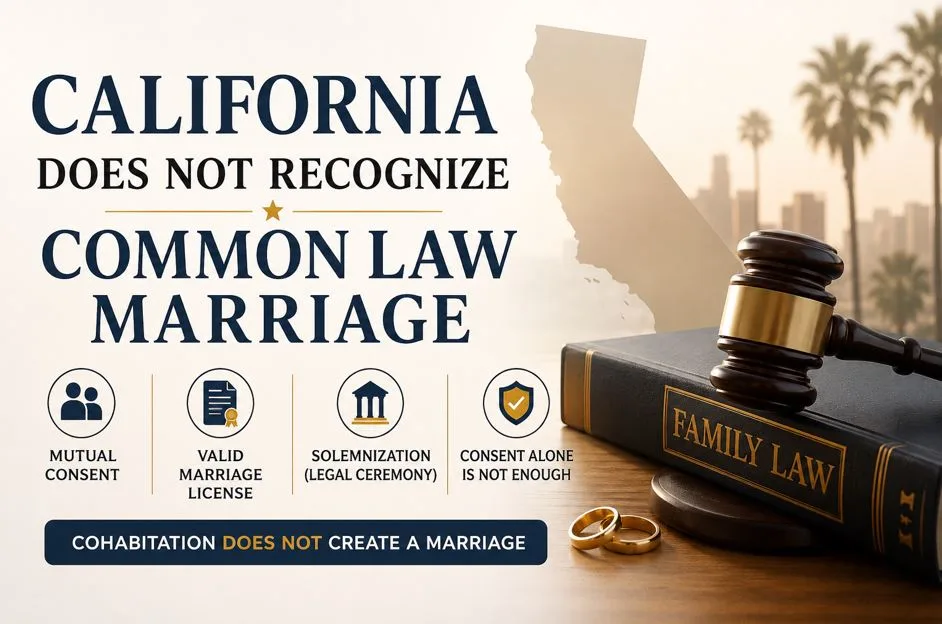
Under California Family Code Section 300, a valid marriage in California requires all three of the following:
- Mutual consent from both individuals
- A valid marriage license issued by the county clerk
- Solemnization — a formal ceremony authorized by state law
Consent alone does not make a marriage legal. Cohabitation for any number of years does not create a marriage. Sharing finances, a home, or a last name does not create a legal marriage in California.
The 7-Year Rule — A Widespread Misunderstanding Worth Clearing Up
Many people believe that living together for seven years automatically creates a legal marriage in California. This belief is understandable — it circulates widely — but it is a misunderstanding of how California law actually works.
California abolished common law marriage over 125 years ago. There is no cohabitation period — seven years, ten years, or twenty — that converts a relationship into a legal marriage here. This belief likely spread because a handful of other states do use cohabitation duration as part of their common law marriage requirements, and that detail crossed state lines in conversation.
As of 2026, no amount of time spent living together creates a legally recognized marriage in California.
Does California Recognize Common Law Marriage From Another State?
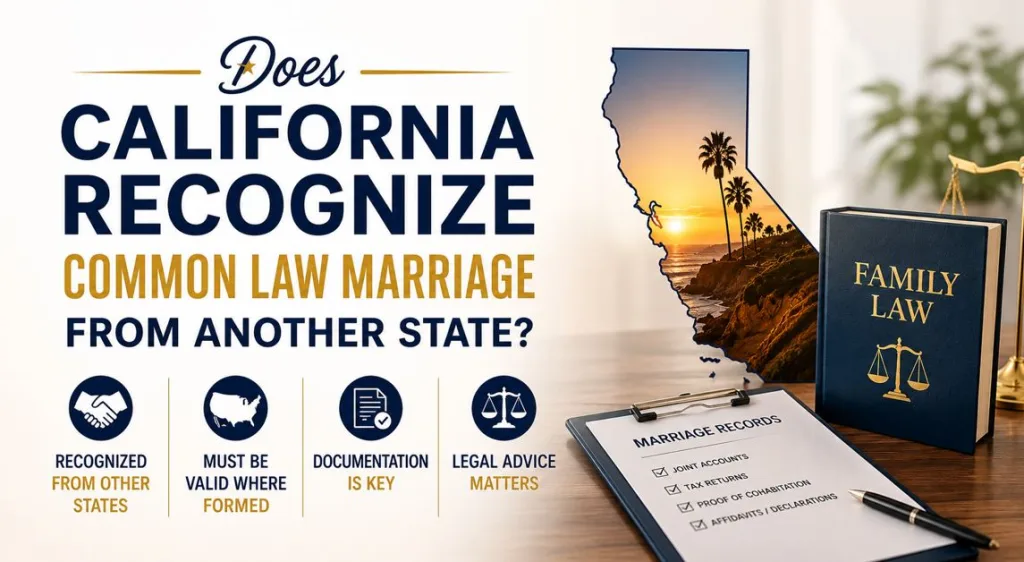
Yes — with one important condition. California will generally honor a common law marriage if it was validly formed in a state that legally permits it before the couple moved to California. This is a well-established legal principle across U.S. states.
As of 2026, the states and jurisdictions that recognize common law marriage include:
| State / Jurisdiction | Status |
| Alabama | Recognized |
| Colorado | Recognized |
| District of Columbia | Recognized |
| Iowa | Recognized |
| Kansas | Recognized |
| Montana | Recognized |
| New Hampshire | Limited recognition |
| Rhode Island | Recognized |
| South Carolina | Recognized |
| Texas | Recognized |
| Utah | Recognized (with conditions) |
Some states on this list recognize common law marriages formed before a specific cutoff date but no longer allow new ones. Requirements also vary — Texas uses a formal declaration or three-part evidence test, while Colorado applies its own standards under state statutes.
If you formed a common law marriage in one of these states and later moved to California, gather solid documentation: joint bank account records, joint tax returns filed as a married couple, correspondence showing you presented yourselves as spouses, and proof of shared residence. A California family law attorney can help you confirm whether your marriage will be recognized under state law.
What Are the Legal Requirements for Marriage in California?
To be legally married in California in 2026, a couple must satisfy these requirements under the California Family Code:
- Both individuals must consent freely and voluntarily
- A valid marriage license must be obtained from a California county clerk
- The marriage must be solemnized — performed by an authorized officiant
- The signed license must be returned and recorded with the county recorder
Both parties must be at least 18 years old, or have court approval if younger. Neither party can be currently married to someone else. Once the license is registered, it becomes an official marriage certificate.
What Is a Putative Spouse in California?
California law includes a specific protection for people who genuinely believed they were legally married — but were not, due to a technical or procedural problem with the marriage.
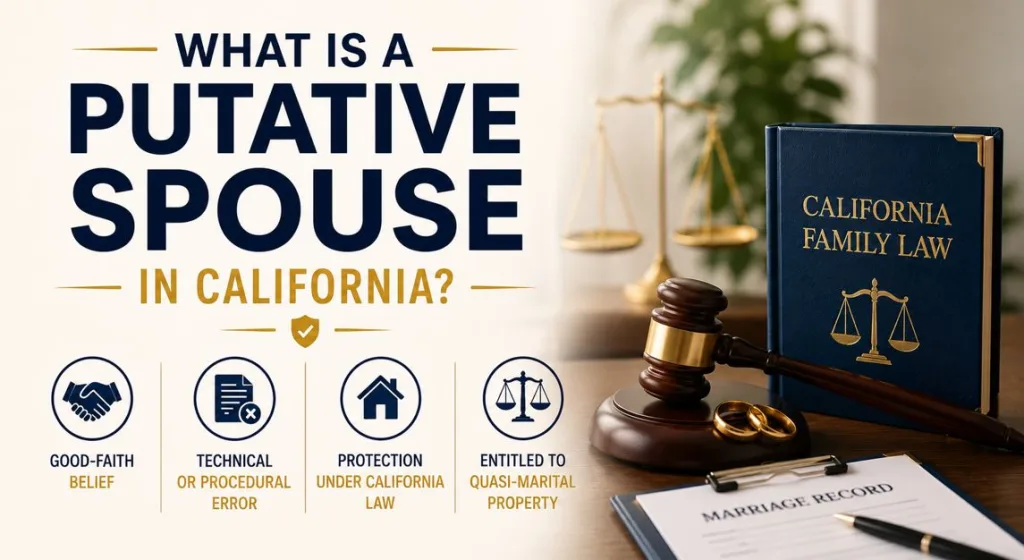
Under California Family Code §2251, if a person had a good-faith, reasonable belief that they entered into a valid marriage, they may be recognized as a “putative spouse.” This can happen when:
- A prior divorce was never finalized before the second marriage
- The officiant at the ceremony was not legally authorized to perform marriages
- The marriage license was never properly filed or recorded
- A technical error occurred during the solemnization process
A putative spouse may be entitled to a division of quasi-marital property — property that would have been considered community property if the marriage had been valid. Courts divide it the same way they would in an actual divorce.
This protection is narrow and precise. It applies to people who genuinely went through the motions of getting married and had a reasonable basis for believing it was valid. Simply living with someone — or assuming that a long relationship equals marriage — does not qualify for putative spouse status.
Legal Rights of Unmarried Couples in California (2026)
California does not recognize common law marriage, but unmarried couples still have meaningful legal options available to them. These rights work differently than those that come with formal marriage — but they are real and worth understanding.
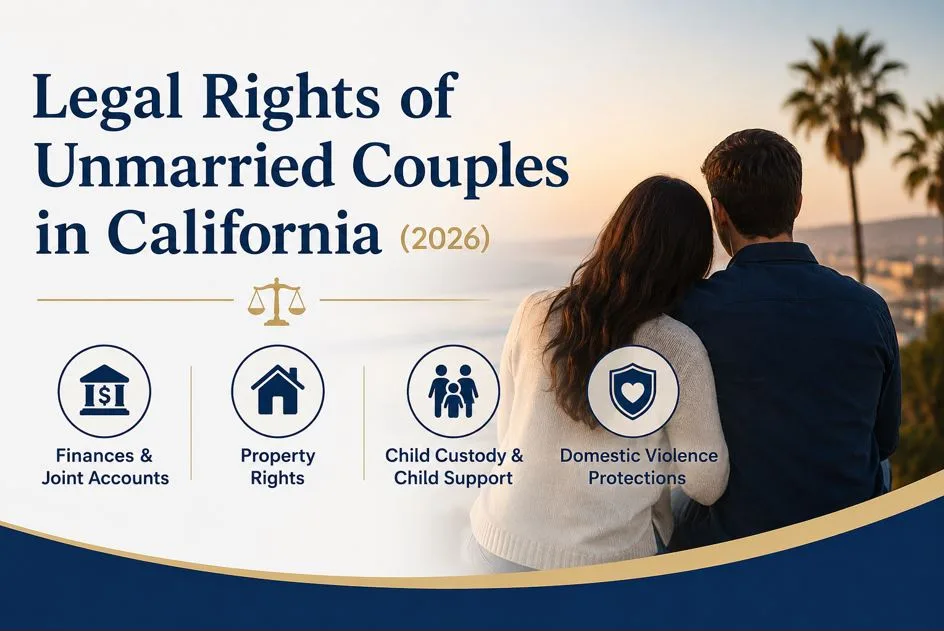
Finances and Joint Accounts
Under California law, two unmarried people living together are treated as two legally separate individuals where finances are concerned. Bank accounts, investments, and savings are owned individually unless both names are formally on the account.
If a couple holds any asset jointly, it will be divided equally if the relationship ends — unless a separate written agreement says otherwise. Alimony and spousal support are available to married couples only, though child support remains available to any parent, married or not.
Property Rights
An unmarried couple that owns property together will have it divided equally upon separation, assuming both names are on the title. If only one partner’s name is on the deed but both contributed financially to the purchase or mortgage payments, the other partner may have grounds to seek a share through a civil court claim.
These cases are handled under contract and equity law — not family law — and they require clear evidence of financial contribution. Courts look at each situation individually and weigh the specific facts.
Child Custody and Child Support
Unmarried parents have equal rights regarding their children. Either parent can pursue a child custody arrangement through California family court. If paternity is in question, a court can order a paternity test to legally establish the father’s identity.
Once paternity is established, child support obligations apply in the same way they would for a divorcing married couple. California uses the same statewide child support guidelines regardless of whether the parents were ever married.
Domestic Violence Protections
Unmarried couples in California have the same access to domestic violence protections as married couples. A partner experiencing abuse can seek an emergency protective order or a domestic violence restraining order through the California courts. Relationship status — married, unmarried, registered, or not — does not affect a person’s ability to request court protection.
California Domestic Partnership — A Legal Alternative to Marriage
California offers registered domestic partnerships (RDPs) as a recognized alternative to marriage. Under California Family Code §297 and SB 30 (effective 2020), both same-sex and opposite-sex couples can register as domestic partners.
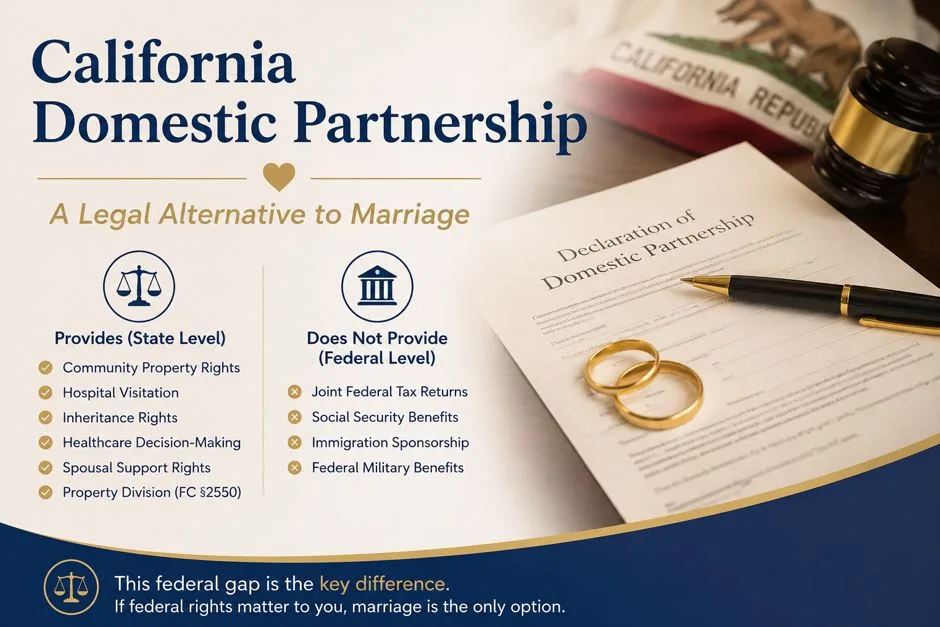
To register, both partners must:
- Be at least 18 years old
- Not currently be married or in another domestic partnership
- Share a common residence
- Be able to give legal consent
Registration involves filing a Declaration of Domestic Partnership with the California Secretary of State and paying the applicable fee.
What an RDP provides at the state level:
- Community property rights
- Hospital visitation rights
- Inheritance rights
- The ability to make healthcare decisions for a partner
- Spousal support rights upon dissolution
- The same property division rules as marriage under FC §2550
What an RDP does not provide at the federal level (as of 2026):
- The ability to file joint federal tax returns
- Social Security survivor or spousal benefits based on a partner’s earnings
- Immigration sponsorship rights for a non-citizen partner
- Access to federal military spouse benefits
This federal gap is the single most important distinction between domestic partnership and marriage in 2026. If any of these federal rights matter to your situation, formal marriage remains the only path.
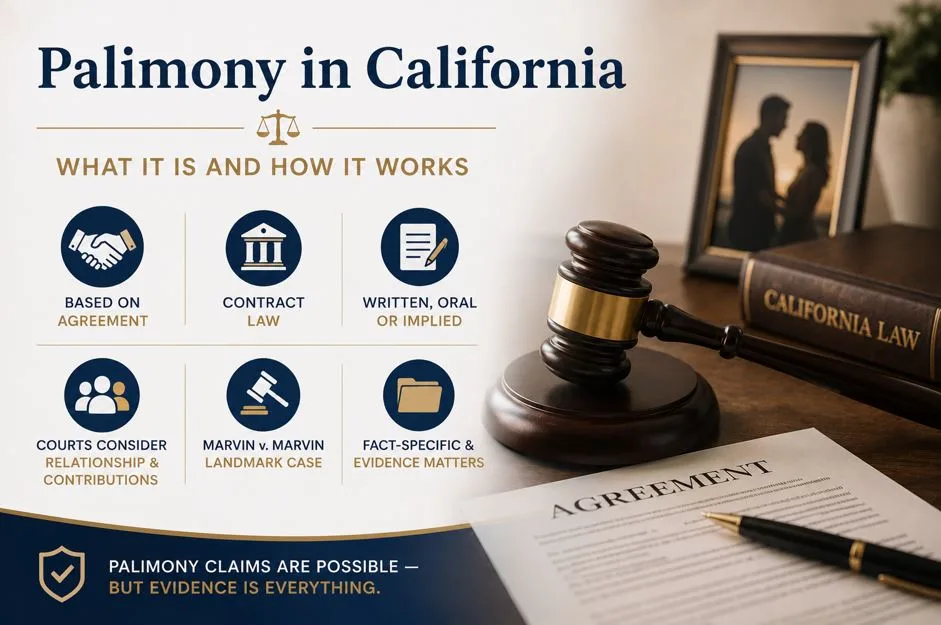
Palimony in California — What It Is and How It Works
Palimony refers to financial support one partner pays another after the end of a non-marital relationship. California does not have a specific palimony statute, but courts can recognize palimony claims when an agreement — written, oral, or implied by conduct — existed between the partners.
This principle comes from the landmark California Supreme Court case Marvin v. Marvin, which established that non-married partners can seek financial support based on contract law, not family law. Courts examine the length of the relationship, each partner’s financial contributions, and any explicit or implied promises about support or shared assets.
Palimony vs. Spousal Support — Key Differences:
| Palimony | Spousal Support | |
| Legal basis | Contract law | California Family Code |
| Requires marriage | No | Yes |
| Has a formula | No — case by case | Yes — structured guidelines |
| Court type | Civil court | Family court |
| Burden of proof | Clear and convincing | Preponderance of evidence |
Palimony claims are possible but they are fact-specific and require solid evidence of an agreement. Oral contracts are the most difficult to prove in civil court. Written agreements are far stronger. An implied agreement — based on the couple’s actual conduct and shared arrangements — can also be recognized, but again, evidence matters.
Common Law Marriage and Taxes in California
Unmarried couples who are not registered domestic partners file their California state taxes as single individuals — or as head of household if they qualify based on dependents. They cannot file jointly.
California registered domestic partners file state taxes using the same status options as married couples: married/RDP filing jointly, married/RDP filing separately, head of household, or qualifying surviving spouse. The California Franchise Tax Board treats RDPs and married couples identically for state tax purposes.
At the federal level, domestic partners who are not legally married must file as single (or head of household where applicable). They cannot file joint federal returns, and different deduction rules apply. This remains one of the more practically significant differences between an RDP and a legal marriage in 2026.
Does Social Security Recognize Common Law Marriage in California?
The Social Security Administration (SSA) applies the law of the state where the couple most recently lived together when determining whether a marriage — including a common law marriage — is valid for benefits purposes.
Since California does not recognize common law marriage, a couple that only ever lived together in California would not qualify for Social Security spousal or survivor benefits based on a common law relationship.
However, if a couple formed a valid common law marriage in a state that recognizes it (such as Texas or Colorado) and then moved to California, the SSA may recognize that marriage for benefit purposes — because the marriage was valid where it was formed.
California registered domestic partners may be eligible for Social Security survivor and spousal benefits, provided they meet all applicable requirements under federal law and California law. This is a nuanced area, and it is worth consulting a benefits advisor or attorney if this question applies to your situation.
Common Law Marriage and Immigration in California
For immigration purposes, the U.S. government recognizes marriages — including common law marriages — if they were legally formed under the laws of the place where they occurred.
Since California does not permit common law marriages to form here, a California cohabiting couple cannot use their relationship to sponsor a non-citizen partner for immigration. Only a valid, licensed marriage — or, in limited cases, a common law marriage validly formed in a qualifying state — can be the basis for a spousal visa or green card petition.
Domestic partnerships, even registered California domestic partnerships, are not recognized by U.S. immigration authorities for spousal immigration purposes. If immigration is a concern, legal marriage is the required path.
Inheritance Rights for Unmarried Couples in California
Under California’s intestate succession laws, unmarried partners have no automatic right to inherit from each other. If a partner passes away without a will, the estate passes to the closest legal relatives — children, parents, or siblings — not to an unmarried partner.
To protect a partner’s inheritance rights, the following documents are essential:
- A will that names the partner as a beneficiary
- A revocable living trust for assets beyond basic needs
- Beneficiary designations on life insurance, retirement accounts, and financial accounts
- A durable power of attorney for financial decisions
- An advance healthcare directive so a partner can make medical decisions
Registered domestic partners do inherit automatically under California law in the same way that spouses do. But for couples without a formal registration, these documents are the only reliable protection.
Common Law Marriage California 2026: Key Misunderstandings Clarified
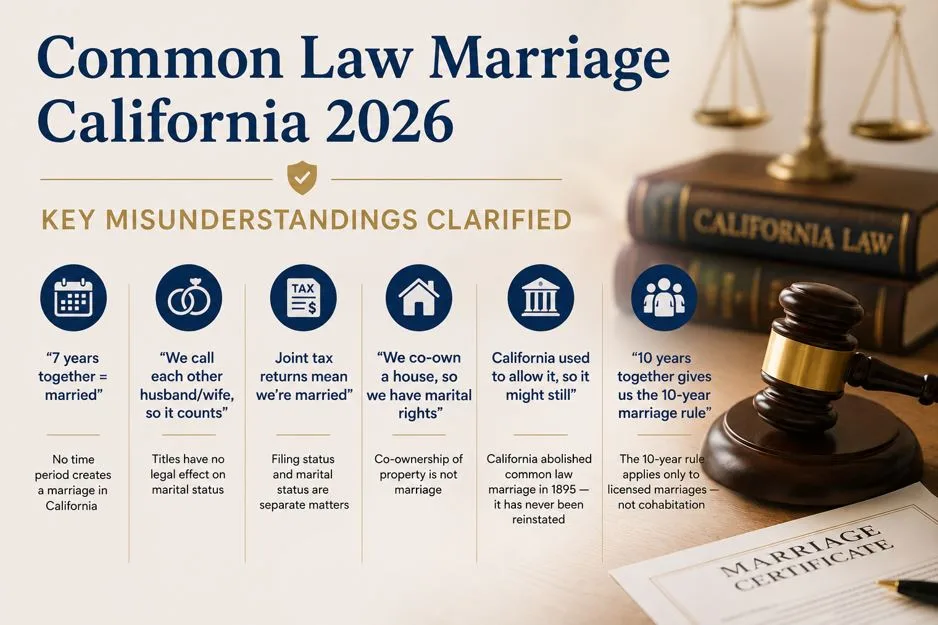
Here are the most common misunderstandings I come across, stated clearly:
| Belief | What California Law Actually Says |
| “7 years together = married” | No time period creates a marriage in California |
| “We call each other husband/wife, so it counts” | Titles have no legal effect on marital status |
| “Joint tax returns mean we’re married” | Filing status and marital status are separate matters |
| “We co-own a house, so we have marital rights” | Co-ownership of property is not marriage |
| “California used to allow it, so it might still” | California abolished common law marriage in 1895 — it has never been reinstated |
| “10 years together gives us the 10-year marriage rule” | The 10-year rule applies only to licensed marriages — not cohabitation |
What Unmarried Couples in California Should Do in 2026
If you are in a committed relationship in California without a formal marriage, here is a clear checklist to protect yourself and your partner:
- Register as domestic partners with the California Secretary of State for state-level legal recognition
- Create a cohabitation agreement that outlines how property and finances are handled
- Draft a will and name your partner as a beneficiary
- Update beneficiary designations on all insurance policies, retirement accounts, and bank accounts
- Sign a durable power of attorney for both financial and healthcare decisions
- Consult a family law attorney — especially if you are dealing with a family law matter that involves children, shared property, or support questions
The California Courts self-help website offers free legal resources and forms for unmarried couples navigating these questions.
For more California-specific guides on legal matters, housing, and local resources, explore our California Local Guides section.
The Bottom Line
Does California recognize common law marriage? No — and it has not since 1895. California law requires a valid license, mutual consent, and a formal ceremony for a marriage to be legally recognized. No length of cohabitation, shared finances, or informal commitment creates a marriage under California law.
That said, unmarried couples in California have real options: domestic partnership registration, cohabitation agreements, wills, powers of attorney, and palimony claims where applicable. The key is to take deliberate steps rather than assume the law covers you automatically — because in California, it requires you to set those protections up yourself.