
Most Dangerous Cities in California (2026): 25 Cities Ranked by Crime Data
I’ve spent a lot of time driving through California cities that most travel guides skip entirely. As the lead researcher at CA Travel Times, I make it a point to go beyond the pretty pictures — because readers deserve to know the full story about a place, not just the highlight reel.
This guide covers the most dangerous cities in California for 2026, ranked by actual crime data from the FBI Uniform Crime Reporting (UCR) Program and the California Department of Justice (CA DOJ). I cross-referenced local law enforcement reports, PPIC regional analysis, and NeighborhoodScout statistics to build a list that reflects what’s actually happening on the ground — not just what makes a headline.
Key Takeaways
- Oakland leads all major California cities in violent crime, posting 16.85 violent incidents per 1,000 residents — roughly 327% above the national average. Despite this, 2025 brought the city’s single largest year-over-year crime drop in decades.
- Emeryville has the highest property crime rate in California, at roughly 124 incidents per 1,000 residents — driven almost entirely by organized retail theft and vehicle break-ins near its Bay Street commercial corridor.
- The San Joaquin Valley is California’s most dangerous region overall, recording 603 violent crimes per 100,000 residents in 2024 — 25% above the statewide average, according to PPIC.
- Statewide, property crime reached its lowest point since 1985 (CA DOJ, 2024), but shoplifting remains 48% above pre-pandemic levels — a split that matters when evaluating individual city risk.
- Proposition 36, which took effect in December 2024, increases penalties for repeat theft offenders and organized retail crime. Prosecution depends on documented evidence, making on-the-ground reporting more critical than ever.
- Crime is deeply hyperlocal. Even in California’s most dangerous cities, risk levels can vary dramatically by neighborhood, time of day, and proximity to transit hubs or commercial zones.
- Bakersfield ranks as California’s most dangerous city for pedestrians, with a pedestrian death rate of 3.99 per 100,000 people — surpassing what the worst-ranked city held five years ago, per Smart Growth America’s Dangerous by Design report.
- California is not the most dangerous state. New Mexico, Alaska, and Louisiana consistently record higher violent crime rates. California’s statewide homicide rate hit its second-lowest level since 1966 in 2024.
How We Ranked These Cities?
Rankings are built on two primary crime metrics drawn from FBI UCR and CA DOJ 2024 data:
- Violent Crime Rate (per 1,000 residents) covers homicide, rape, robbery, and aggravated assault. These offenses directly threaten personal safety and drive public safety perceptions.
- Property Crime Rate (per 1,000 residents) covers burglary, larceny and retail theft, and motor vehicle theft. Property crimes occur more frequently and heavily shape overall crime statistics.
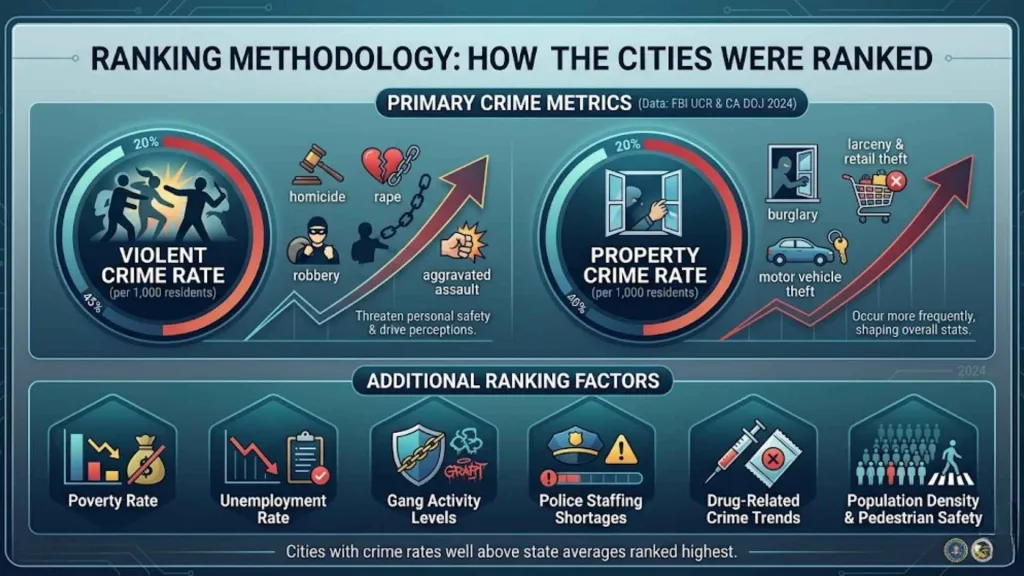
Additional ranking factors include poverty and unemployment rates, gang activity levels, police staffing shortages, drug-related crime trends, population density, and pedestrian safety data. Cities with crime rates well above state averages ranked highest on this list.
California’s statewide violent crime rate stands at 480.3 incidents per 100,000 residents. Every city on this list sits significantly above that figure.
25 Most Dangerous Cities in California (2026)
1. Emeryville — Highest Property Crime Rate in the State
Emeryville is the smallest city on this list and the one with the most extreme numbers. With a population of around 13,000, it logs a property crime rate of roughly 124 incidents per 1,000 residents — the highest per capita in all of California. Violent crime sits at about 8 per 1,000 residents, which also exceeds state averages.
The driver is geography and retail density. Its Bay Street shopping corridor draws organized retail crime groups from across the Bay Area. Vehicle break-ins happen routinely in parking structures and lots. Police staffing reductions have stretched response times. If you are shopping here, treat your car like a vault — leave nothing visible inside.
| Crime Type | Rate per 1,000 Residents |
| Violent Crime | ~8.0 |
| Property Crime | ~124 |
| Motor Vehicle Theft | ~78 |
| Aggravated Assault | 1.56 |
2. Commerce — Small City, Outsized Crime Burden
Commerce sits southeast of Los Angeles with roughly 11,400 residents but a property crime rate pushing 103 incidents per 1,000 people. Violent crime runs at about 12.21 per 1,000, which is exceptionally high for a city this size.
Its industrial layout — warehouses, distribution centers, and commercial corridors — creates steady opportunity for opportunistic theft. Vehicle theft and larceny drive most of the numbers. The city recorded 25 gun violence incidents in the most recent reporting period. Commerce does not get the media coverage that Oakland or Stockton does, but for its population size, it carries one of the heaviest crime loads in the state.
3. Oakland — California’s Most Dangerous Major City
Oakland is the name that comes up most when people talk about the most dangerous cities in California, and the data backs that up for violent crime. With a population of around 429,000, the city recorded a violent crime rate of roughly 16.85 per 1,000 residents — about 327% above the national average.
Gun violence is concentrated in East Oakland, where gang activity, chronic police understaffing, and concentrated poverty feed a cycle that community programs alone haven’t been able to break. That said, 2025 brought Oakland’s most dramatic single-year crime decline in decades. Homicides fell 22%, armed robberies dropped over 40%, and commercial burglaries came down 47% — proof that targeted investment does move the needle.
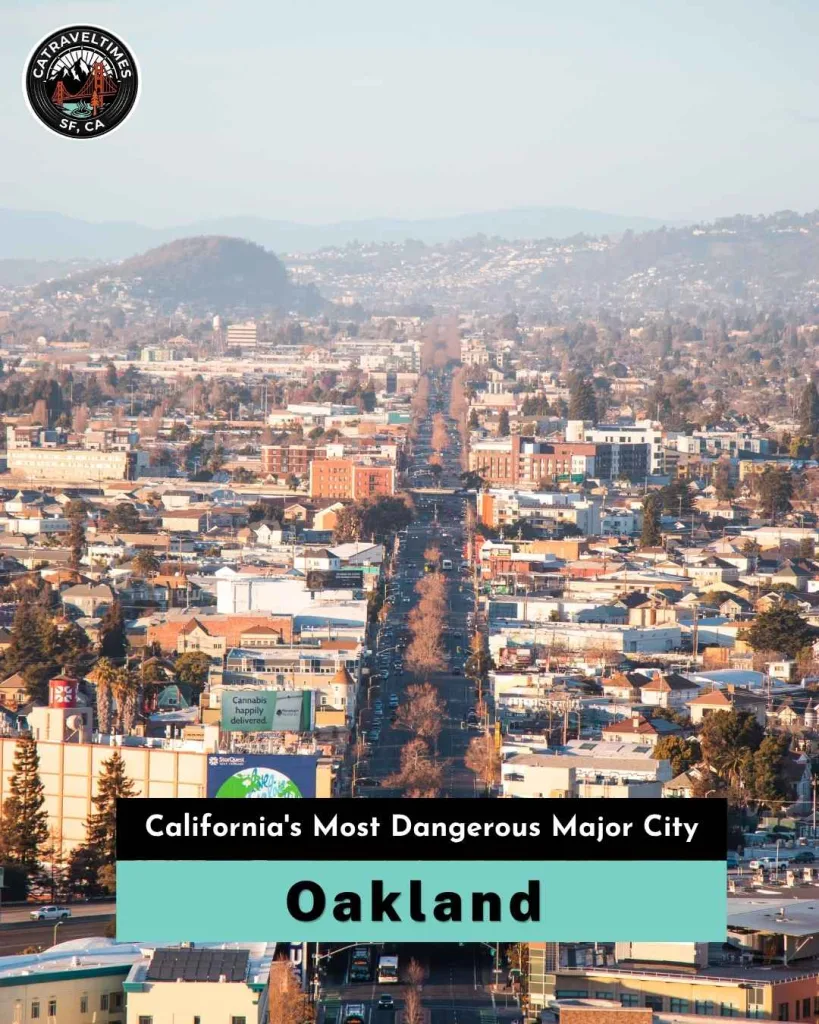
For solo travelers and nighttime workers, the risk varies sharply by neighborhood. Downtown and Temescal feel different than the flatlands of East Oakland after midnight hours.
| Crime Type | Rate per 1,000 Residents |
| Violent Crime | 16.85 |
| Property Crime | 60.23 |
| Homicide | 0.31 |
| Motor Vehicle Theft | 17.60 |
| Gun Violence Incidents | 285 |
4. San Bernardino — Southern California’s Auto Theft Capital
San Bernardino’s violent crime rate of 14.91 per 1,000 residents places it firmly among the most dangerous cities in California. The number that stands out most, however, is its motor vehicle theft rate — roughly 99.67 per 1,000 residents, one of the highest in the entire country.
High poverty rates, methamphetamine-related offenses, and a historically understaffed police force have combined to keep crime elevated. The city recorded 145 gun violence incidents in the most recent data period. San Bernardino County saw property crime fall 14.9% in 2024 — but city-level numbers remain well above state averages. For family relocations, the specific neighborhood you choose within San Bernardino makes an enormous difference.
5. Stockton — The Central Valley’s Most Violent City
Stockton has been on these lists for years, and 2026 data does not change that. A violent crime rate of 13.96 per 1,000 residents and 270 recorded gun violence incidents reflect a city still wrestling with gang-related homicides concentrated in southside neighborhoods.
The San Joaquin Valley, where Stockton sits, recorded the highest regional violent crime rate in California in 2024 — 603 per 100,000 residents, 25% above the state average. Property crime runs at 33.62 per 1,000 residents, with vehicle theft being the biggest single driver. For delivery drivers and people working near transit hubs in Stockton, evening hours carry the highest risk.
| Crime Type | Rate per 1,000 Residents |
| Violent Crime | 13.96 |
| Property Crime | 33.62 |
| Homicide | 0.27 |
| Motor Vehicle Theft | 52.26 |
| Gun Violence Incidents | 270 |

6. Marysville — Northern California’s Overlooked Danger
Marysville rarely appears in national crime conversations, but this Northern California city of around 12,700 residents posts a violent crime rate of 12.96 per 1,000 residents — higher than many cities that draw far more attention. Property crime sits at 46.11 per 1,000, driven largely by motor vehicle theft and larceny.
Limited law enforcement resources, high poverty rates, and a small tax base leave the city with fewer tools to address crime trends. Nineteen gun violence incidents were recorded in the most recent period. It is the kind of place where the numbers speak loudly precisely because most people are not paying attention.
7. Barstow — Mojave Desert City With Disproportionate Crime
Barstow is a desert city of about 25,000 people on I-15 between Los Angeles and Las Vegas. Its violent crime rate of 10.77 per 1,000 residents and property crime rate of 38.83 per 1,000 far exceed what you would expect for a town this size and location.
Drug-related offenses play a significant role in both crime categories. The city recorded 22 gun violence incidents. Near abandoned lots and poorly lit stretches — especially after dark — crime risk climbs noticeably. For travelers stopping here, keep vehicles locked and belongings out of sight.

8. Red Bluff — Tehama County’s Persistent Crime Problem
Red Bluff, with about 14,000 residents in Tehama County, posts a violent crime rate of roughly 10.08 per 1,000 residents and property crime near 49 per 1,000. Larceny and vehicle theft drive most of those numbers.
The city sits in a region with limited economic opportunity and inadequate law enforcement coverage for its geographic spread. Fourteen gun violence incidents were recorded. For residents and travelers moving through the area, the risk is real even if the city rarely makes state headlines.
9. Vallejo — Bay Area Hotspot With Police Staffing Gaps
Vallejo’s violent crime rate of 9.65 per 1,000 residents has made it a consistent fixture in Bay Area crime discussions. Gun violence and aggravated assault incidents remain elevated, and the city has struggled with police staffing shortages that limit both proactive policing and response times.
Property crime sits at 34.18 per 1,000 residents. Thirty-one gun violence incidents were recorded. Community trust issues with local law enforcement complicate the path to improvement. Vallejo’s situation reflects what happens when fiscal constraints and systemic inequality go unaddressed for an extended period.
10. Richmond — Active Programs, Still Elevated Numbers
Richmond recorded a violent crime rate of 9.20 per 1,000 residents with gang-related shootings concentrated in the Iron Triangle neighborhood. Property crime runs at 35.87 per 1,000 residents, with motor vehicle theft and burglary leading the numbers. The city recorded 53 gun violence incidents.
What sets Richmond apart is genuine investment in solutions. Its Operation Peacemaker Fellowship violence intervention program has been linked in peer-reviewed research to 55% fewer annual firearm deaths and 43% fewer firearm-related crimes. Progress is real — but overall rates remain well above California averages.

11. Signal Hill — Hidden Property Crime Problem in Southern California
Signal Hill is a small city of about 11,600 people completely surrounded by Long Beach. Its property crime rate of 68.49 per 1,000 residents is among the highest in the state, driven almost entirely by larceny and vehicle theft. Violent crime sits at 7.96 per 1,000. Six gun violence incidents were recorded.
The city’s limited size means fewer police resources, and its commercial strips see consistent theft activity. It is a city most people drive through without realizing what the numbers show.
12. Merced — Central Valley City Under Pressure
Merced recorded a violent crime rate of 7.82 per 1,000 residents, significantly above the state average. Property crime sits at 25.93 per 1,000, with motor vehicle theft and larceny as the leading categories.
The city of roughly 95,000 residents has 33 recorded gun violence incidents. Economic hardship, limited employment options, and strain on local law enforcement resources all contribute to crime patterns that have resisted improvement despite community programs.
13. Modesto — Rising Crime Trends in the Central Valley
Modesto recorded a violent crime rate of 7.41 per 1,000 residents with property crime at 27.32 per 1,000. Robberies and aggravated assaults have trended upward in recent years, and vehicle theft remains a persistent issue throughout the city.
With a population of over 216,000, Modesto sits in a region where the overall violent crime rate runs 25% above the state average. Drug-related offenses and economic hardship shape the underlying crime profile. Thirty-one gun violence incidents were recorded.
14. Eureka — Northern California’s Most Dangerous City
Eureka, a coastal city of about 25,600 residents in Humboldt County, posted a violent crime rate of 6.87 per 1,000 residents with property crime at 45.42 per 1,000. Larceny and vehicle theft dominate the crime landscape.
Drug-related offenses — particularly methamphetamine — drive a significant share of both violent and property crime. Twenty-nine gun violence incidents were recorded. For a city of its size, Eureka’s numbers are notably high, driven partly by a struggling local economy and limited access to mental health and substance abuse services.
15. Fresno — Pedestrian Danger and Persistent Property Crime
Fresno is one of California’s biggest cities, home to nearly 549,000 people. Its violent crime rate of about 6.77 per 1,000 residents is lower than cities higher on this list, but its property crime rate of 33.58 per 1,000 — with vehicle theft and larceny at the center — keeps it on the radar.
Gang activity in certain districts contributes to violent offenses, and 89 gun violence incidents were recorded. On the positive side, Fresno’s hospital-based violence intervention program has shown a 42% decline in gunshot wound victims over a multi-year period, according to a city evaluation published in 2024.
For families and for solo travelers, Fresno requires neighborhood-level awareness — the northwest side differs sharply from the areas around downtown.

16. Sacramento — California’s Capital Has a Crime Problem
Sacramento, the state capital, recorded a violent crime rate of 6.74 per 1,000 residents with property crime at 31.93 per 1,000. Larceny and motor vehicle theft are the top property crime drivers. Seventy-seven gun violence incidents were recorded.
The city faces recurring challenges with drug-related offenses and property crime near transit hubs and commercial corridors. Despite being the center of California’s statewide policy conversations on crime, Sacramento itself struggles with above-average numbers across multiple crime categories.
17. Inglewood — Event City With Persistent Urban Crime
Inglewood’s profile shifted with the arrival of SoFi Stadium and other major entertainment venues, but its violent crime rate of 6.19 per 1,000 residents and property crime rate of 25.81 per 1,000 remain real concerns. Thirty-one gun violence incidents were recorded.
Robberies and aggravated assaults are the leading violent crime categories. During tourist season and around major events, areas near transit hubs see elevated opportunistic crime. Urban crime pressures from rapid development and population density continue to strain local public safety resources.
18. Salinas — Persistent Gang Activity in Agricultural Country
Salinas, with around 156,900 residents in Monterey County, recorded a violent crime rate of 5.28 per 1,000 residents with property crime at 24.10 per 1,000. Motor vehicle theft and larceny are most prevalent.
Gang activity drives a disproportionate share of violent offenses in specific neighborhoods — a pattern that has persisted for decades despite community programs. Forty-one gun violence incidents were recorded, making Salinas one of the more dangerous mid-sized California cities relative to its population.
19. Antioch — East Bay City With Rising Crime Concerns
Antioch recorded a violent crime rate of 5.17 per 1,000 residents with property crime at 26.53 per 1,000. Motor vehicle theft and larceny feature prominently. Thirty-three gun violence incidents were recorded.
The city of about 115,000 residents in Contra Costa County has faced scrutiny over law enforcement conduct and staffing challenges in recent years. Crime spans multiple categories — murders, robberies, aggravated assaults, and property offenses — making it one of the more complex public safety environments in the Bay Area.

20. Bakersfield — California’s Most Dangerous City for Pedestrians
Bakersfield carries two significant designations. Its property crime rate of 42.80 per 1,000 residents and violent crime at 4.94 per 1,000 keep it on statewide lists year after year. It also holds the title of California’s most dangerous city for pedestrians, with a pedestrian death rate of 3.99 per 100,000 people — ranked fourth worst nationally by Smart Growth America, surpassing what the worst-ranked city held five years prior.
Drug-related crime, gang activity, and vehicle theft are primary drivers of the overall crime profile. Kern County saw a 17.2% drop in violent crime in 2024, but city-level property crime and pedestrian danger remain serious public safety concerns. Thirty-three gun violence incidents were recorded.
21. Compton — South Los Angeles’s Ongoing Challenge
Compton, with a population of around 100,000 in Los Angeles County, has long dealt with gang-related violent crime and elevated property offenses. Homicide rates and aggravated assault figures remain above state averages, with gang territories across multiple neighborhoods contributing to a persistently elevated crime profile.
Drug-related offenses and vehicle theft add to the burden. Socioeconomic disparities — including high poverty rates and unemployment well above state averages — are deeply connected to the crime patterns that community programs alone have not resolved. It is a city where the concentration of poverty in specific neighborhoods directly shapes the crime data.

22. Victorville — High Desert City With Growing Crime
Victorville sits in San Bernardino County’s High Desert with a population of around 135,000. Vehicle theft, larceny, and property crime have increased in recent years, driven partly by its position as a regional commercial hub and its location along major freight routes.
Violent crime including aggravated assaults and gang-related incidents has trended upward, reflecting both population growth outpacing resources and the socioeconomic pressures common across the High Desert region. For real estate buyers evaluating the Inland Empire, Victorville’s crime trend line deserves careful review.
23. San Francisco — High Property Crime Despite Falling Violent Crime
San Francisco occupies a unique position on this list. Violent crime is lower than most other cities here — but property crime, particularly in the Tenderloin District and parts of SoMa, remains among the highest of any major American city.
Vehicle break-ins, retail theft, and drug-related property offenses continue to affect residents, visitors, and businesses citywide. Organized retail crime has been especially damaging to commercial corridors. The Bay Area as a whole recorded the highest property crime rate in California at 2,678 per 100,000 residents. For solo travelers, keeping valuables out of vehicles entirely is non-negotiable.

24. Los Angeles — Scale Amplifies Everything
Los Angeles does not top per-capita crime lists, but its size — nearly 4 million residents — means the raw volume of violent incidents is enormous. Areas including South Central Los Angeles, Skid Row, and parts of the San Fernando Valley see crime rates far above city averages.
Homicide, aggravated assault, robbery, and vehicle theft are consistent concerns in high-crime districts. Gang violence remains a major driver of firearm-related incidents citywide. During holiday periods and after major events, urban crime pressures intensify around commercial and entertainment zones across the metro.

25. Turlock — Where Central Valley Crime Risk Spreads Beyond the Headlines
The San Joaquin Valley’s crime pressure does not stay neatly inside the boundaries of its most well-known cities. Turlock, with around 75,000 residents near Modesto, has seen vehicle theft and property crime escalate in recent years — consistent with the broader regional trend. The San Joaquin Valley as a whole recorded 603 violent crimes per 100,000 residents in 2024, 25% above the statewide average.
While Turlock’s individual numbers are lower than Stockton or Modesto, property crime trends are moving in the wrong direction and local law enforcement resources are strained. For anyone evaluating the Central Valley for relocation or investment, the regional crime landscape matters as much as any single city’s statistics.
2026 Crime Statistics: Full Rankings Table
| Rank | City | Violent Crime Rate (per 1,000) | Property Crime Rate (per 1,000) | Primary Concerns |
| 1 | Emeryville | ~8.0 | ~124 | Retail theft, vehicle break-ins |
| 2 | Commerce | ~12.2 | ~103 | Industrial theft, larceny |
| 3 | Oakland | 16.85 | 60.23 | Gang violence, gun crime |
| 4 | San Bernardino | 14.91 | 30.64 | Auto theft, meth crime |
| 5 | Stockton | 13.96 | 33.62 | Gang homicides, vehicle theft |
| 6 | Marysville | 12.96 | 46.11 | Larceny, vehicle theft |
| 7 | Barstow | 10.77 | 38.83 | Drug crime, property theft |
| 8 | Red Bluff | 10.08 | 49.01 | Larceny, vehicle theft |
| 9 | Vallejo | 9.65 | 34.18 | Gun violence, staffing gaps |
| 10 | Richmond | 9.20 | 35.87 | Gang assaults, burglary |
| 11 | Signal Hill | 7.96 | 68.49 | Property crime, larceny |
| 12 | Merced | 7.82 | 25.93 | Vehicle theft, assault |
| 13 | Modesto | 7.41 | 27.32 | Robbery, vehicle theft |
| 14 | Eureka | 6.87 | 45.42 | Larceny, drug crime |
| 15 | Fresno | 6.77 | 33.58 | Vehicle theft, pedestrian danger |
| 16 | Sacramento | 6.74 | 31.93 | Larceny, motor vehicle theft |
| 17 | Inglewood | 6.19 | 25.81 | Robbery, event-area crime |
| 18 | Salinas | 5.28 | 24.10 | Gang violence, vehicle theft |
| 19 | Antioch | 5.17 | 26.53 | Robbery, property crime |
| 20 | Bakersfield | 4.94 | 42.80 | Pedestrian danger, drug crime |
| 21 | Compton | Above avg | Above avg | Gang violence, homicide |
| 22 | Victorville | Rising | Rising | Vehicle theft, property crime |
| 23 | San Francisco | Lower violent | Very high property | Retail theft, vehicle break-ins |
| 24 | Los Angeles | Above avg | Above avg | Volume crime, gang activity |
| 25 | Turlock | Elevated | Elevated | Spillover regional crime trends |
Rates sourced from NeighborhoodScout, CA DOJ 2024 Crime in California Report, and local law enforcement data.
Key Factors Driving Crime in California Cities
The same set of factors appears consistently across nearly every city on this list. Understanding them makes the data easier to read.
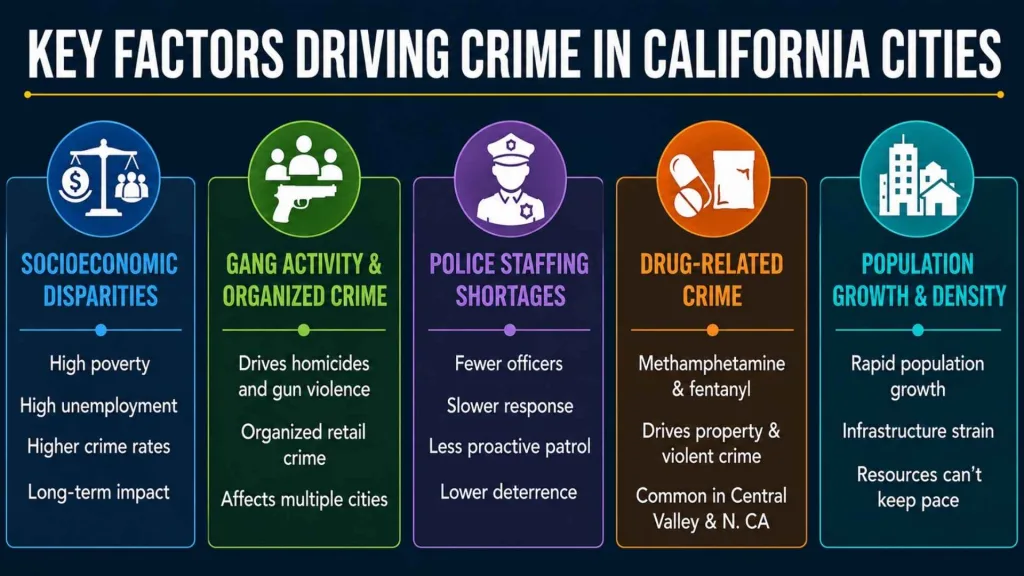
- Socioeconomic disparities sit at the root of most California crime trends. Cities where poverty rates exceed 20% and unemployment runs high consistently post elevated violent and property crime. Several cities on this list — Stockton, San Bernardino, Compton — sit above that threshold. Economic investment produces measurable long-term results, but the timeline is long.
- Gang activity and organized crime remain the single biggest drivers of homicides and gun violence in cities like Oakland, Stockton, Bakersfield, and Richmond. Organized retail crime — coordinated groups operating across multiple cities — fuels property crime numbers in commercial hubs like Emeryville and Commerce.
- Police staffing shortages affect nearly every city on this list. Fewer officers mean slower response times, reduced proactive patrol, and less deterrence. Several California cities have been losing officers faster than they recruit replacements — Vallejo and Oakland are the most often cited, but the problem is statewide.
- Drug-related crime — particularly methamphetamine and fentanyl — contributes to both property crime and violent offenses across the Central Valley and parts of Northern California. Bakersfield, Fresno, Eureka, and Red Bluff all show significant drug-driven patterns.
- Population density and rapid growth create additional strain in cities growing faster than their infrastructure can handle. Stockton, Victorville, and Inglewood all show this pattern — population rising alongside crime as resources fail to keep pace.
California Crime Trends in 2026: What the Statewide Data Shows
California’s statewide crime picture is improving. The California Department of Justice’s 2024 Crime in California report shows violent crime dropped 6% to 480.3 per 100,000 residents, homicide hit its second-lowest rate since 1966, and property crime reached its lowest point since 1985.
Proposition 36, passed in November 2024, strengthens penalties for repeat theft and organized retail crime. However, statewide averages hide sharp local gaps — the San Joaquin Valley runs 25% above average for violent crime, while some Southern California counties sit well below it. Improvement is real, but uneven.
Community-Driven Solutions That Are Working
Several California cities are seeing real results from targeted programs — worth noting alongside the raw crime data.
- Richmond’s Operation Peacemaker Fellowship — peer-reviewed in the American Journal of Public Health — was associated with 55% fewer annual firearm deaths and 43% fewer firearm-related crimes in the city.
- Oakland’s 2025 turnaround involved both increased law enforcement operations and community investment. Homicides fell 22%, armed robberies dropped 40%, and commercial burglaries declined 47% in a single year — the most dramatic improvement in the city’s recent history.
- Fresno’s hospital-based violence intervention program produced a 42% decline in gunshot wound victims and a 50% reduction in citywide shootings over its evaluation period, per a BSCC local evaluation report published in 2024.
Community policing programs, youth outreach, mental health service expansion, and neighborhood revitalization efforts have all shown measurable results in specific districts — even where citywide statistics have not yet fully reflected the change.
California’s Safest Cities: A Direct Contrast
Not all of California looks like this list. Many cities maintain crime rates well below national averages. Frequently cited among California’s safest:
- Irvine — repeatedly ranked among the safest large cities in the United States
- Thousand Oaks — consistently low violent and property crime rates
- Mission Viejo — among the lowest crime rates per capita in the state
- Rancho Santa Margarita — strong community engagement, well-funded law enforcement
- Simi Valley — low across both violent and property crime categories
- Danville — small Northern California city with excellent public safety metrics
- Aliso Viejo — low crime, high median income, strong community programs
- Lincoln — rapidly growing but consistently low crime rates
- Yorba Linda — one of Orange County’s safest communities
These cities share higher median incomes, stronger tax bases for law enforcement, lower poverty rates, and fewer of the socioeconomic pressures driving crime in the cities above.
For a deeper look at specific regions — including safest neighborhoods and places actually worth visiting — our California Local Guides break down what each area is really like on the ground.
Practical Safety Tips for Travelers and Residents
If you are visiting or living in any of the cities on this list, a few habits make a real difference:
- Never leave anything visible in your vehicle, especially near retail centers, transit hubs, or parking structures. Emeryville, Oakland, San Francisco, and Commerce are particularly high risk for vehicle break-ins.
- Be extra cautious after midnight hours, particularly in East Oakland, Stockton’s southside, San Bernardino, and Compton.
- Avoid poorly lit areas and spots near abandoned lots, especially in Barstow, Eureka, and Red Bluff where street lighting is inconsistent.
- Use rideshare after dark rather than walking in unfamiliar neighborhoods, especially in Inglewood near entertainment venues during holiday periods and major events.
- As a pedestrian, be especially alert in Bakersfield, Fresno, Stockton, and the Riverside–San Bernardino area — all ranked among the most dangerous nationally for people on foot.
- For family relocations, research specific neighborhoods before committing. Crime rates within the same city can vary by 300% or more across zip codes. In Oakland, the north hills and downtown core are very different from East Oakland flatlands.
- For real estate buyers, check hyperlocal crime maps by address before making any decisions. City-level averages hide a lot.
Final Thoughts
California’s crime picture in 2026 is genuinely mixed. Some cities — Oakland most dramatically — have seen real, measurable improvement in a short time. Others, particularly across the Central Valley and parts of the Inland Empire, are still working through challenges tied to poverty, gang violence, and underfunded institutions.
What I keep coming back to after doing this research: statewide stats do not tell you whether a specific street in a specific city is safe. Two zip codes in the same municipality can have completely different risk profiles. Use this data as your starting point — then dig into the specific area you are evaluating. That is exactly what we are here to help you do at CA Travel Times.
Frequently Asked Questions
What is the #1 most dangerous city in California?
By violent crime rate among major cities, Oakland ranks first at 16.85 incidents per 1,000 residents. By property crime per capita, Emeryville leads at roughly 124 incidents per 1,000. By combined crime index across both categories, Oakland takes the overall top spot.
What are the 5 most dangerous cities in California?
Oakland, San Bernardino, Stockton, Emeryville, and Commerce — the first three for violent crime, the last two for exceptional property crime rates.
Is Stockton one of the most dangerous cities in California?
Yes. Stockton has one of the highest violent crime rates among California’s larger cities, driven by gang-related homicides and gun violence concentrated in southside neighborhoods. It sits in the San Joaquin Valley, the highest-crime region in the entire state.
Is San Bernardino one of the most dangerous cities in California?
Yes. With a violent crime rate near 15 per 1,000 and a motor vehicle theft rate of nearly 100 per 1,000 — among the highest in the country — San Bernardino consistently ranks among California’s most dangerous cities.
What are the most dangerous cities in Southern California?
San Bernardino, Commerce, Inglewood, Bakersfield, Compton, and Victorville rank among the most dangerous cities in Southern California based on combined violent and property crime data.