How to Hike Lower Yosemite Falls Trail (Map, Time & Parking Tips)
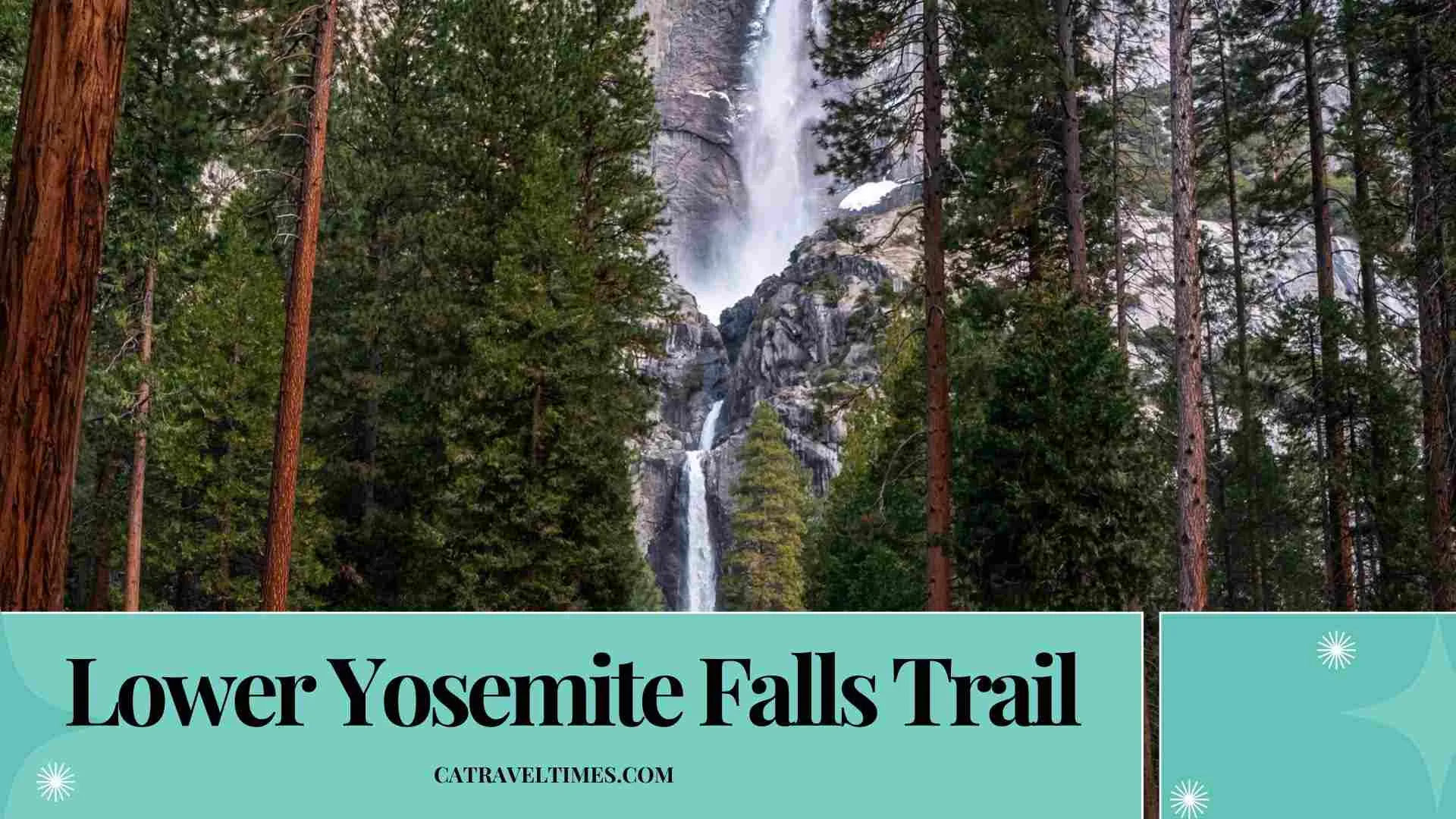
I still remember the exact moment I rounded the first bend on the Lower Yosemite Falls Trail and the full wall of falling water came into view. My jaw literally dropped. I had read about it, seen photos, watched videos none of it prepared me for the real thing.
That thundering 320-foot cascade, perfectly framed between towering pines and grey granite walls, hit me with a sudden gust of cold mist before I had even reached the bridge.
It was May, peak snowmelt season, and within seconds I was completely, happily soaked. I had taken the free Valley Shuttle to Stop #6 just after sunrise, and the trail was still quiet with only a handful of early risers around me. If you are planning a visit to Yosemite National Park, this trail is absolutely non-negotiable and I am going to tell you everything you need to know before you go, straight from personal experience.
What Is the Lower Yosemite Falls Trail?
The Lower Yosemite Falls Trail is a short, paved loop trail inside Yosemite Valley that takes you right to the base of Lower Yosemite Fall, the final 320-foot (98-meter) drop of the tallest waterfall in North America. Yosemite Falls in total stretches 2,425 feet, making it the fifth tallest in the world.
What sets this particular trail apart from every other Yosemite hike I have done is how much reward it delivers for so little effort.
I have also done the Upper Yosemite Fall hike (a strenuous 7.2-mile beast that left my legs sore for two days), and while that summit view is extraordinary, nothing quite matched the raw intimacy of standing at the base of Lower Yosemite Fall, feeling the mist on my face and hearing the water crash onto granite boulders just feet in front of me. It felt personal. Almost overwhelming.
Lower Yosemite Falls Trail: Quick Overview
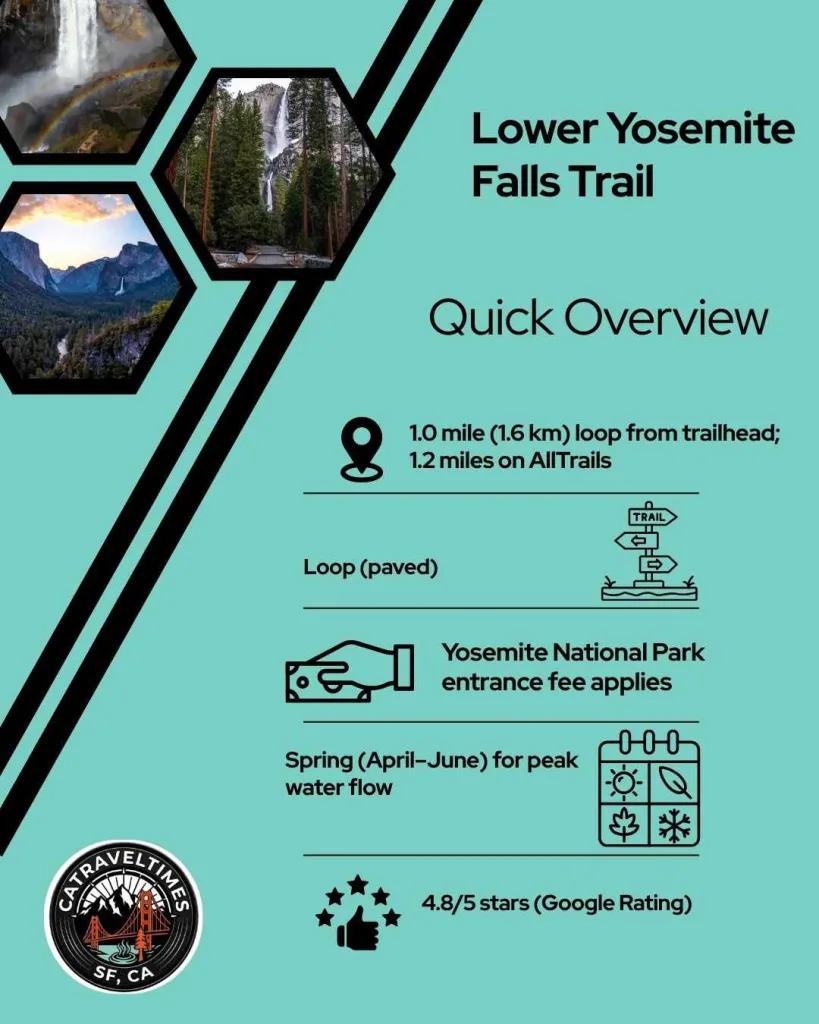
Before I get into the full experience, here is a quick-reference table with all the key stats:
| Detail | Info |
| Trail Type | Loop (paved) |
| Lower Yosemite Falls Trail Distance | 1.0 mile (1.6 km) loop from trailhead; 1.2 miles on AllTrails |
| Lower Yosemite Falls Trail Length (from Yosemite Village) | ~1.5 miles round trip |
| Elevation Gain | ~50 feet (15 meters) |
| Lower Yosemite Falls Trail Time | 30 to 45 minutes (I personally spent close to an hour, mostly just standing at the bridge in disbelief) |
| Lower Yosemite Falls Trail Difficulty | Easy — suitable for all ages and fitness levels |
| Dog Friendly | Yes — leashed dogs permitted |
| Wheelchair Accessible | Yes — fully paved (eastern loop preferred) |
| Open | Year-round |
| Best Season | Spring (April–June) for peak water flow |
| Entry Fee | Yosemite National Park entrance fee applies |
Lower Yosemite Falls Trail Map & Route Description
Yosemite Falls drops in three stages: Upper (1,430 ft), Middle (675 ft), and Lower (320 ft). Standing at the base on my visit, even just that lowest stage was absolutely commanding. I kept craning my neck upward and still couldn’t quite take it all in. Here is how I walked the trail:
Walking Clockwise (My Recommended Direction):
Starting from the western trailhead near the restrooms, I took the wide paved path straight toward the falls. The western side of the loop offers a stunning single-frame view of both Upper and Lower Yosemite Falls. After about a quarter mile, the trail curves north through a mixed forest with interpretive signs, then bends west toward the base of the falls.
At the Lower Yosemite Falls Bridge:
Wooden footbridge over Yosemite Creek is the hike’s highlight spring mist & roar overwhelm instantly! The concrete terrace offers great views. Caution: rocks are dangerously slippery. Eastern loop winds back through forest, connecting to Valley Loop Trail toward Yosemite Village & Mirror Lake.
Download the official Yosemite Valley map from the National Park Service website before your visit. It shows the full loop in context with shuttle stops and parking areas.
Lower Yosemite Fall Trailhead: Where to Start
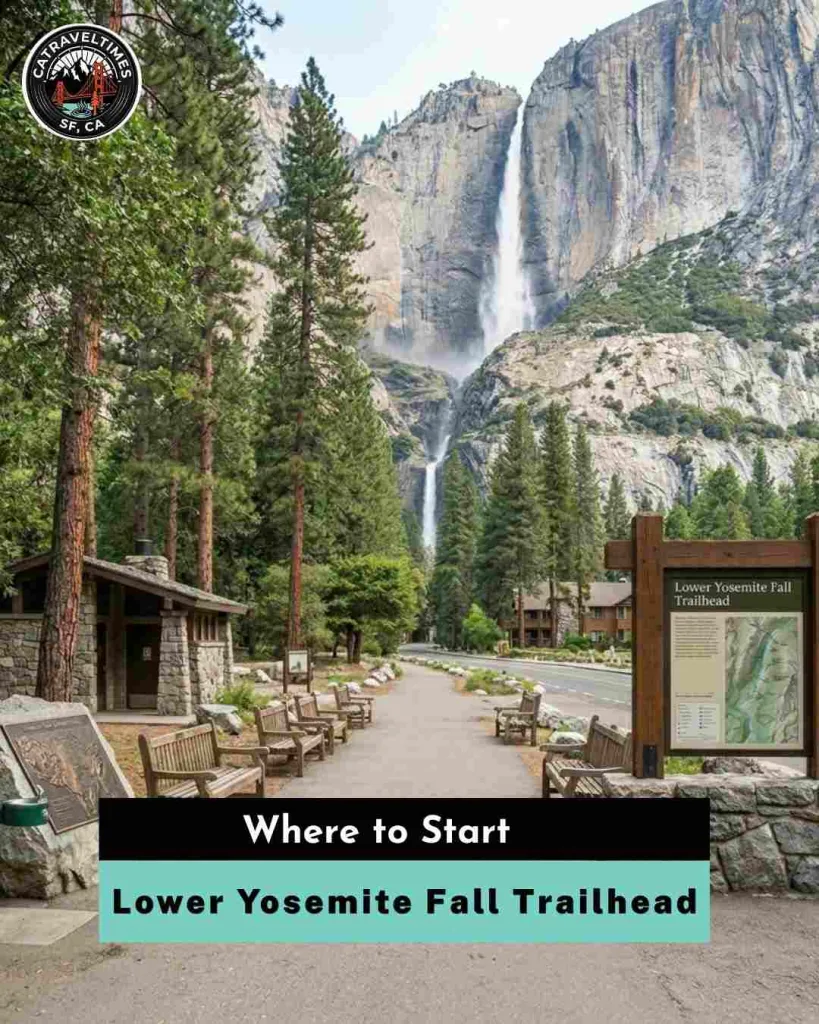
The Lower Yosemite Fall Trailhead is located off Northside Drive in Yosemite Valley, at shuttle stop #6. This is the most convenient starting point by far, and the one I used on my visit. The trailhead sits directly across from Yosemite Valley Lodge (now called Yosemite Valley Lodge at the Falls).
Right at the western trailhead, you will find restrooms, benches, interpretive exhibits, and a water bottle filling station all thoughtfully placed before you even hit the trail.
The NPS has also installed bronze relief map panels along the route, including one that depicts the entire Yosemite Falls drainage system. I spent a few minutes studying it on my way in, and it gave me real context for what I was about to see.
Lower Yosemite Falls Trail: Where to Park
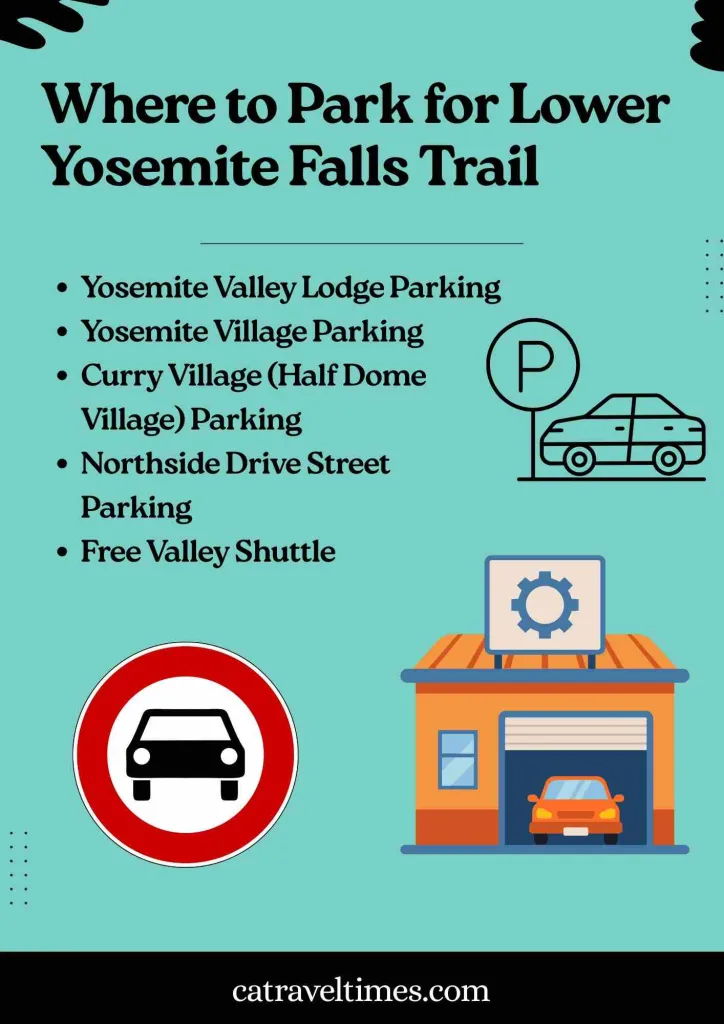
Parking is genuinely the trickiest part of this hike, and I learned this the hard way on my first visit. There is no dedicated parking lot at the trailhead itself. Here is what I have found through my visits:
- Yosemite Valley Lodge Parking: The most convenient option. Park at the lodge lot and the trailhead is just steps away. On busy spring days this fills up fast, often by 8 or 9 AM.
- Yosemite Village Parking: A slightly longer walk (about 0.75 miles one-way via the paved path), but this large lot is your best bet when the lodge lot is full.
- Curry Village (Half Dome Village) Parking: Another viable option — walk or catch the free shuttle from there.
- Northside Drive Street Parking: Very limited roadside spots along Northside Drive. You would need to arrive before 8 AM to have any real shot at one.
- Free Valley Shuttle: This is the strategy I switched to and it made everything easier. I parked at a valley lot and took the free Yosemite Valley Shuttle directly to stop #6. It runs frequently in season, it is free, and it completely eliminates the parking battle. Bicycles are also a great option — racks are available at both ends of the loop trail.
My personal tip: On my spring visit I arrived at the valley around 6:45 AM and caught an early shuttle with no wait at all. By the time I finished the hike and was heading back around 9 AM, I could see a long queue forming at the shuttle stop and the lodge lot was completely full. Early arrival is everything here.
Lower Yosemite Falls Trail Difficulty: Is It Hard?
No, this is genuinely one of the easiest hikes I have ever done in any national park. With only about 50 feet of elevation gain across a fully paved surface, the Lower Yosemite Falls Trail difficulty is rated “easy” by every source including the NPS itself and I completely agree. I have done this trail and watched people of every age and ability level complete it comfortably.
The one thing worth noting is a short steep section near the western viewing area, where the last 180 feet of trail have a roughly 13.8% slope. This might require some assistance for wheelchair users. The eastern approach to the viewing area is fully flat and accessible, which is the better route for anyone with mobility considerations.
How Long Does the Lower Yosemite Falls Trail Take?
Plan for somewhere between 30 and 60 minutes. The NPS estimates 30 minutes at a steady pace, which is accurate if you just want to walk through. But in my experience, especially in spring when the falls are thundering and the mist is flying, 45 to 60 minutes is much more realistic. I personally spent close to an hour on my visit and most of that time was simply standing at the bridge, taking it in. I genuinely did not want to leave.
Best Time to Visit: Seasonal Guide
The single most important factor for this hike is water flow. Here is what each season looks like based on my own visits and research:
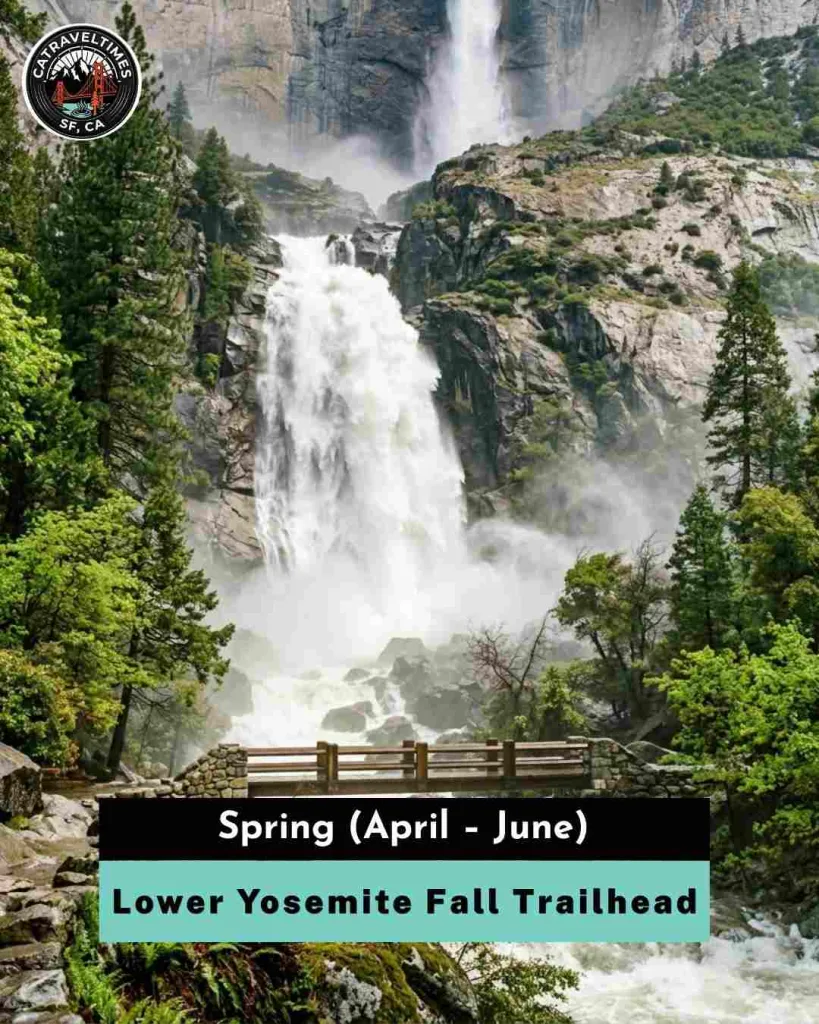
Spring (April – June) — Peak Season
This is when the Lower Yosemite Falls Trail is at its absolute best, and I can say this from direct experience. Snowmelt from the high country sends Yosemite Creek surging, and Lower Yosemite Fall thunders with full, almost violent force. In May, I got completely drenched at the bridge within seconds of my jacket, my hair, my camera bag and I loved every second of it. April and May are the magic months.
Crowds are heavy but manageable if you arrive early, as I did. Spring is also the season for the famous Yosemite moonbow, a rare lunar rainbow that forms in the mist of Lower Yosemite Fall on full moon nights from approximately April through June, visible from the footbridge. I was lucky enough to witness one on my visit, and it is genuinely one of the most surreal and beautiful natural phenomena I have ever seen in my life. A pale arc of color glowing in the darkness, backlit by the falls. Nothing else quite compares.
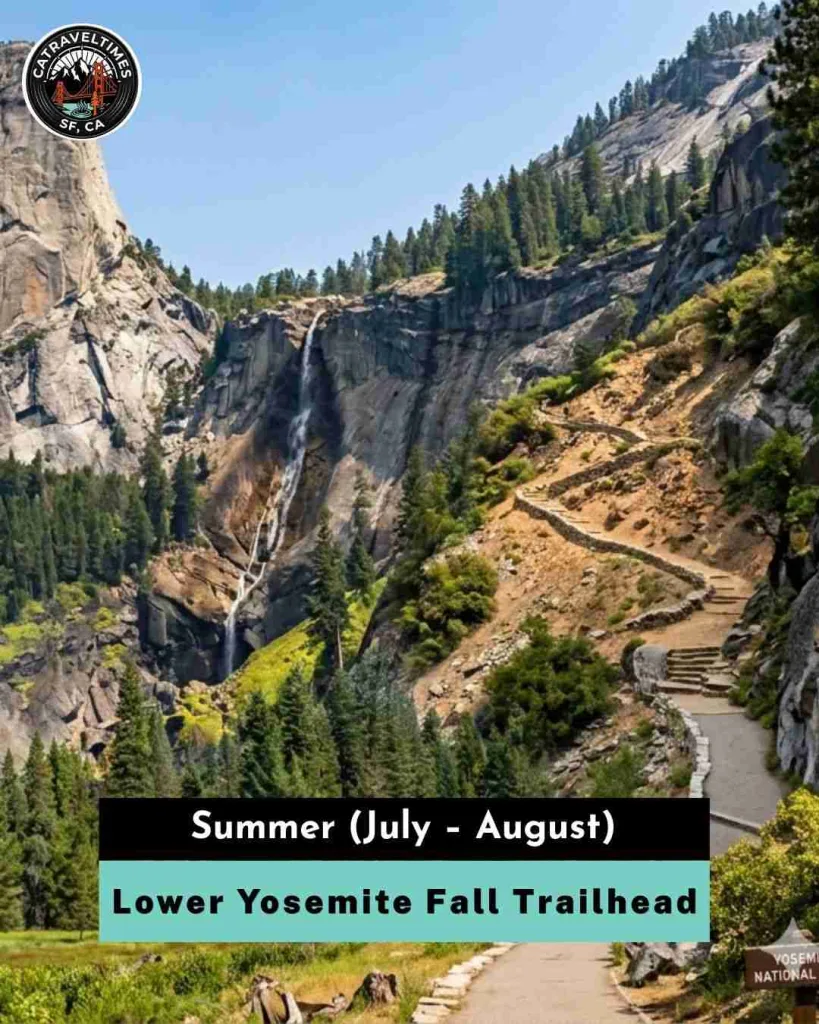
Summer (July – August) — Diminishing Flow
By late July, the waterfall often slows to a trickle or dries up entirely as the snowpack is exhausted. The trail itself is still a pleasant forest walk in summer, but manage your expectations around the waterfall. If peak flow is what you are after, summer is not your window.
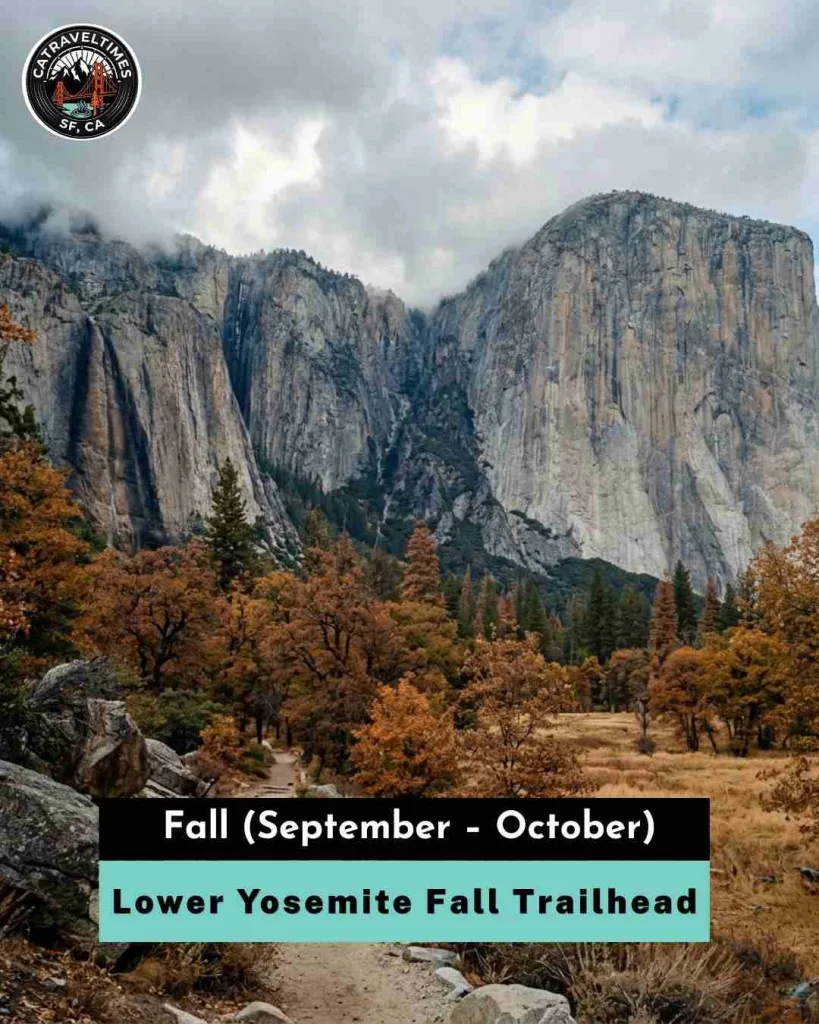
Fall (September – October) — Usually Dry
The falls are typically dry through this period. Late fall storms can occasionally revive some flow, but it is unpredictable. Not the ideal time for this specific trail if the waterfall is your main goal.
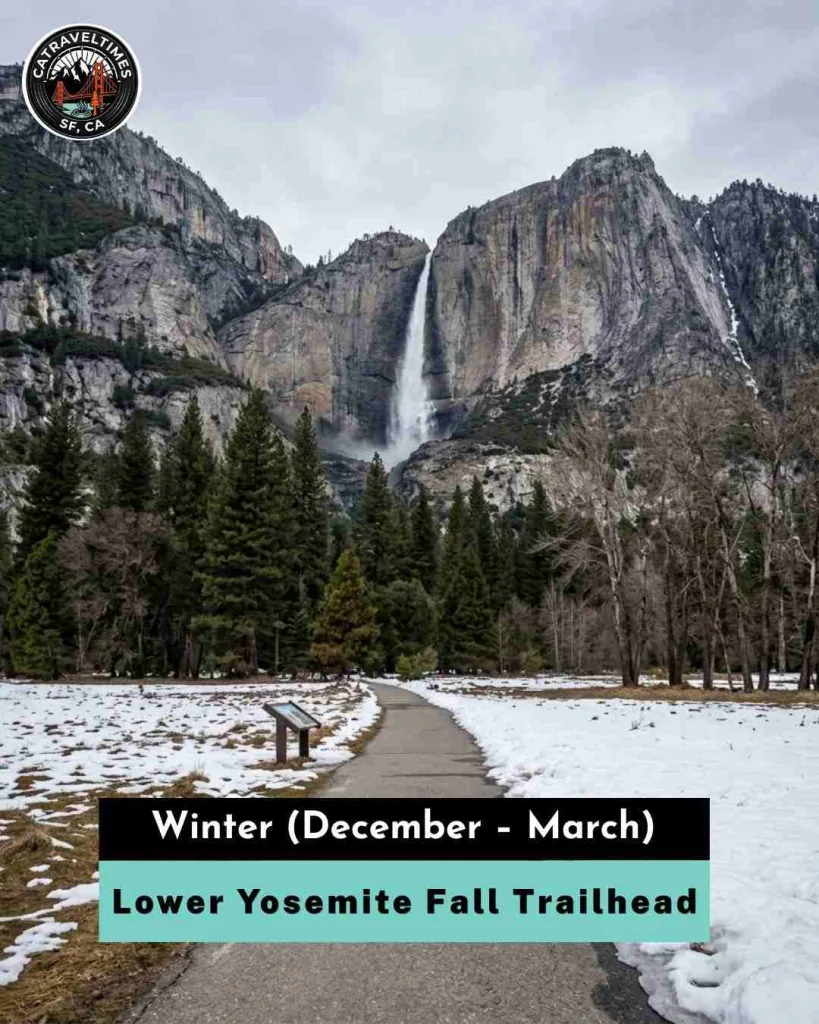
Winter (December – March) — Dramatic and Quiet
Lower Yosemite Falls Trail winter conditions are spectacular in a completely different way. The crowds thin dramatically, the valley takes on a moody and ethereal atmosphere, and a towering cone of frazil ice sometimes forms at the base of Upper Yosemite Fall occasionally exceeding 300 feet tall. The paved trail stays open year-round, but ice can make sections slippery so wear sturdy footwear. The ice cone typically melts by mid-April. I have heard from fellow hikers who did this trail on a cold January morning with just a handful of other people around, and the solitude sounds extraordinary.
Is the Lower Yosemite Falls Trail Dog Friendly?
Yes, leashed dogs are welcome on the Lower Yosemite Falls Trail, and this is something I appreciated knowing before my visit. Because the entire trail is paved, it falls under Yosemite’s general rule that dogs are permitted on fully paved surfaces. Your dog must be on a leash at all times and you are responsible for cleaning up after them.
On my visit I saw several dogs on the trail, and they all seemed to absolutely love the bridge section, the mist, the cold air, the sounds. It is a natural cooling station for them in warmer months. Just keep in mind that dogs are not permitted on unpaved trails in Yosemite or on the shuttle buses, so plan your transportation and parking accordingly so your dog is not left waiting in the car. Dogs are also not allowed inside concessionaire lodging areas.
Is the Lower Yosemite Falls Trail Good for a Wedding or Proposal?
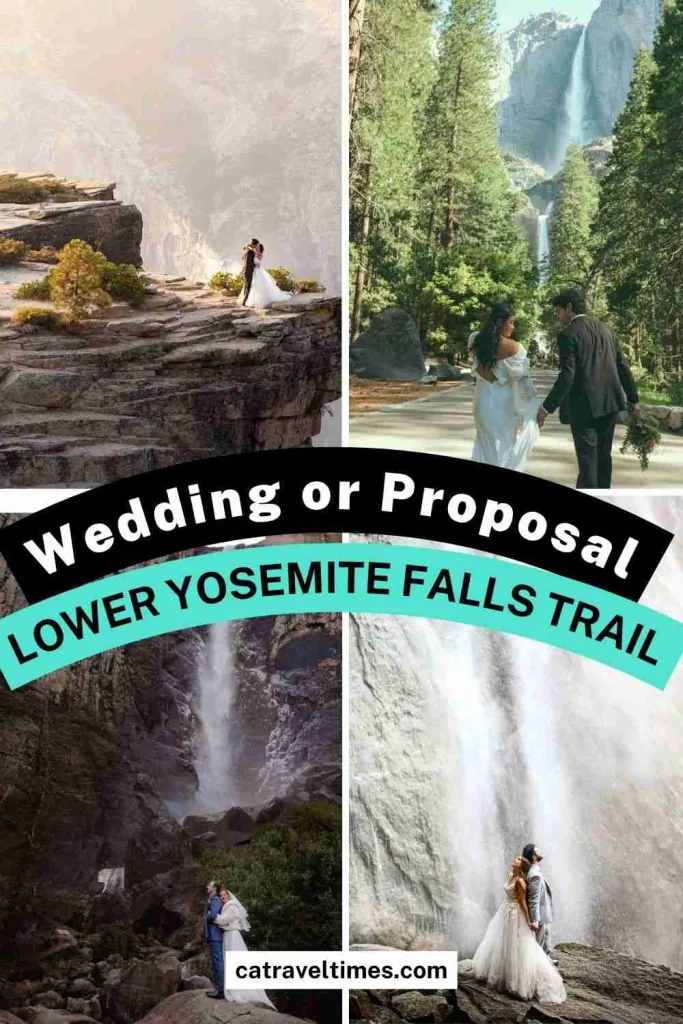
The bridge at the base of Lower Yosemite Fall is one of the most romantic spots in California. Couples frequently choose this location for proposals and even elopement-style ceremonies. The combination of the thundering waterfall, the mist, the towering granite walls, and the forest creates a genuinely cinematic backdrop. If you’re planning a proposal here, I’d suggest arriving at dawn when crowds are thinnest.
The light at golden hour in spring, with the falls in full flow and mist catching the early sun, is extraordinary. For a formal wedding ceremony in Yosemite, you’ll need a Special Use Permit from the NPS plan this well in advance as permits are limited. For inspiration on planning your California adventure, browse our guides on National Parks throughout the state.
What to Bring on the Lower Yosemite Falls Trail
Given how short and easy this hike is, your packing list is minimal but a few things genuinely matter, especially in spring:
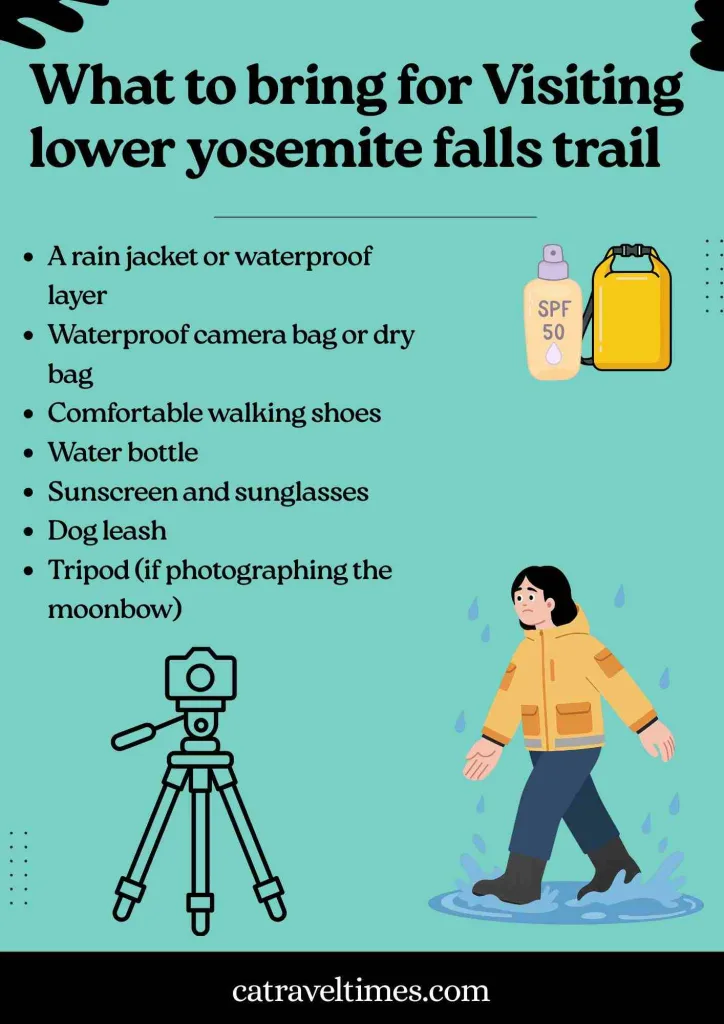
- A rain jacket or waterproof layer — You will get sprayed at the bridge in spring. This is not a maybe. I was drenched within 30 seconds of stepping onto it.
- Waterproof camera bag or dry bag — Protect your phone and camera from the mist. I almost learned this lesson the hard way.
- Comfortable walking shoes — The paved trail does not require hiking boots, but supportive footwear helps on the short steep section near the western viewing area.
- Water bottle — There is a filling station at the trailhead on the western end.
- Sunscreen and sunglasses — The valley gets strong direct sun in summer.
- Dog leash — Non-negotiable if you are bringing a pet.
- Tripod (if photographing the moonbow) — Long-exposure shots require a stable base. A wide-angle lens in the 16–35mm range works best for capturing the full arc in the mist.
Nearby Attractions to Pair With the Lower Yosemite Falls Trail
The Lower Yosemite Falls Trail is so short that you will have plenty of time to explore more of the valley on the same day. Here is what I paired it with on my visit:
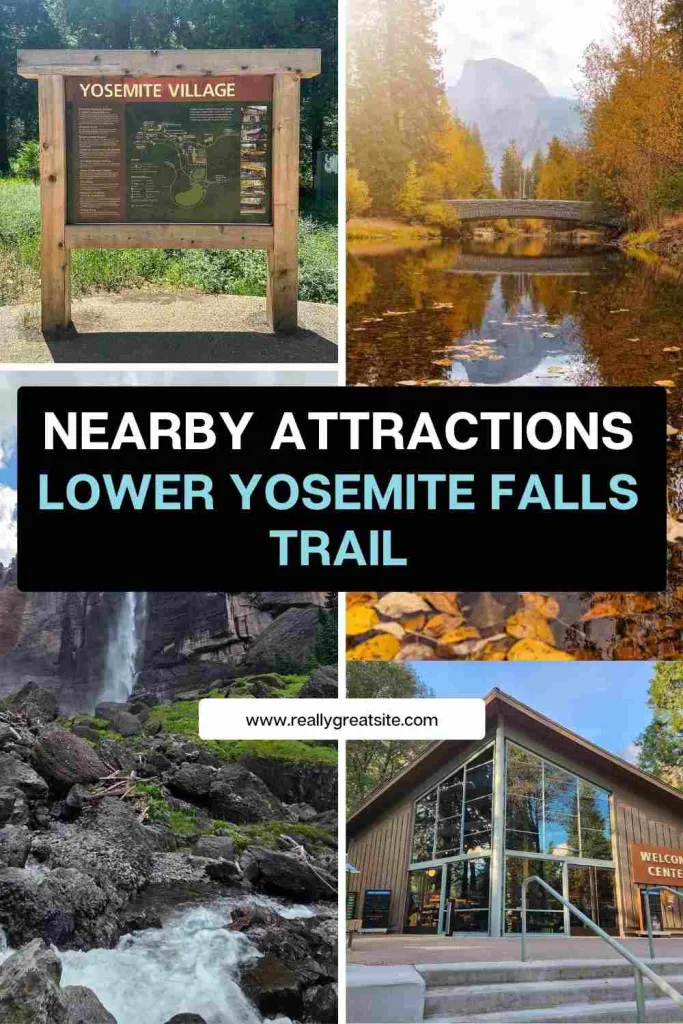
- Cook’s Meadow Loop — A flat 1-mile loop that gives you sweeping views of Yosemite Falls, Half Dome, El Capitan, and Glacier Point. Also one of the secondary viewing locations for the moonbow. Starts right at the Valley Visitor Center.
- Valley Visitor Center — Just east of Yosemite Village, with exhibits on Yosemite’s geology, wildlife, and human history. Free to enter and worth a 30-minute stop.
- Yosemite Village — Ansel Adams Gallery, the park store, dining options, and the Village Grill’s outdoor deck (dog-friendly patio).
- Bridalveil Fall Trail — A short 0.5-mile hike to another beautiful waterfall on the valley’s south side. Note that this trail has been undergoing construction — check current conditions before going.
- Sentinel Bridge — Walk out onto the bridge for the iconic Half Dome reflection shot in the Merced River. Also a secondary location for moonbow viewing from above.
For deeper planning of your entire Yosemite trip, our Yosemite National Park guide covers everything from permits to the best overlooks in the park.
Accessibility Notes
The Lower Yosemite Falls Trail is one of the most accessible hikes in any U.S. national park, and the NPS has clearly put real thought into making it welcoming for everyone. The entire loop is paved. Here is what wheelchair users and stroller users should know:
- Eastern loop approach (from the Yosemite Falls shuttle stop): 0.6 miles one-way to the viewing area, fully wheelchair accessible with transferable seating to granite boulders at wheelchair height at the viewing area.
- Western loop approach (from the trailhead near the lodge): 0.5 miles one-way, mostly accessible, but the last 180 feet include a 13.8% slope that may require assistance.
- There is no designated accessible parking near the trailhead; use the shuttle from accessible parking at the west end of Yosemite Village (approximately 0.3 miles to the eastern side of the loop).
- A bronze relief model of the Yosemite Falls area is located along the western portion of the loop, approximately halfway to the falls — a thoughtful detail for visually impaired visitors.
- An accessible family restroom is located at the trailhead on the western end, directly across from Yosemite Valley Lodge.
My Final Verdict: Is the Lower Yosemite Falls Trail Worth It?
Absolutely, without a single doubt. After my spring visit catching the early shuttle before the crowds arrived, standing on that bridge in the full force of snowmelt-fueled mist, and being lucky enough to witness a moonbow glowing in the darkness on a full moon night I can say with complete confidence that this trail punches far above its weight for the effort required.
Very few places I have ever visited have delivered this level of payoff for this little physical effort. The Lower Yosemite Falls Trail is the perfect first hike in Yosemite for any visitor: accessible, short, stunning, and genuinely moving when the water is in full flow. Come in April or May. Take the free shuttle. Get on the trail by 7 AM. Bring a rain jacket and accept the mist gratefully. Stand on that bridge. Look up at 320 feet of cascading water thundering above you.