
Can Americans Travel to Cuba? A Complete Guide 2026

Cuba sits just 90 miles off the Florida coast. Yet for most of the last six decades, it has remained one of the most legally complicated destinations for U.S. citizens to visit.
So, can Americans travel to Cuba in 2026? The short answer is yes but not as ordinary tourists. U.S. law permits travel to Cuba only under specific, government-approved purposes.
This guide breaks down the legal framework, the approved travel categories, safety conditions on the ground, and the practical steps for planning a compliant trip. If you’re the type of traveler who likes to research every destination this thoroughly, our CATRAVELTIMES has similar deep-dive guides for other trips too.
Can Americans Travel to Cuba Right Now?
Yes, U.S. citizens can currently travel to Cuba. But general tourism and vacation travel remain prohibited by federal law.
The U.S. Department of the Treasury’s Office of Foreign Assets Control (OFAC) regulates all travel to, from, and within Cuba. This applies to anyone under U.S. jurisdiction, including citizens, permanent residents, and even non-citizens physically present in the United States.
Travel to Cuba is only lawful if it falls under one of the recognized categories authorized by a general or specific OFAC license. Traveling without qualifying under one of these categories is illegal and can result in civil penalties.
So, can Americans travel to Cuba for vacation in the traditional sense lying on a beach with no other purpose? No. But if your trip supports the Cuban people, involves family visits, journalism, education, or religious activity, it is entirely legal.
Why Is Travel to Cuba Restricted?
The restrictions trace back to Cold War-era foreign policy, not a general travel ban tied to safety.
The U.S. embargo was designed to limit the flow of American dollars to Cuba’s state-controlled economy. At the same time, it still allows meaningful people-to-people contact.
- The embargo targets the Cuban government’s economic and political structure, not individual travelers.
- U.S. law specifically prohibits tourist activities, while allowing purposeful categories of travel.
- The restrictions are enforced through the Cuban Assets Control Regulations (CACR), administered by OFAC.
The Legal Basis in Brief
Travel-related transactions to Cuba are governed by 31 C.F.R. § 515.560 of the CACR. This regulation lists exactly which activities qualify for general licenses. That means most travelers don’t need to individually apply to OFAC if their trip fits a pre-approved purpose.
When Did Travel to Cuba Become Illegal?
Understanding the history helps explain why the rules look the way they do today.
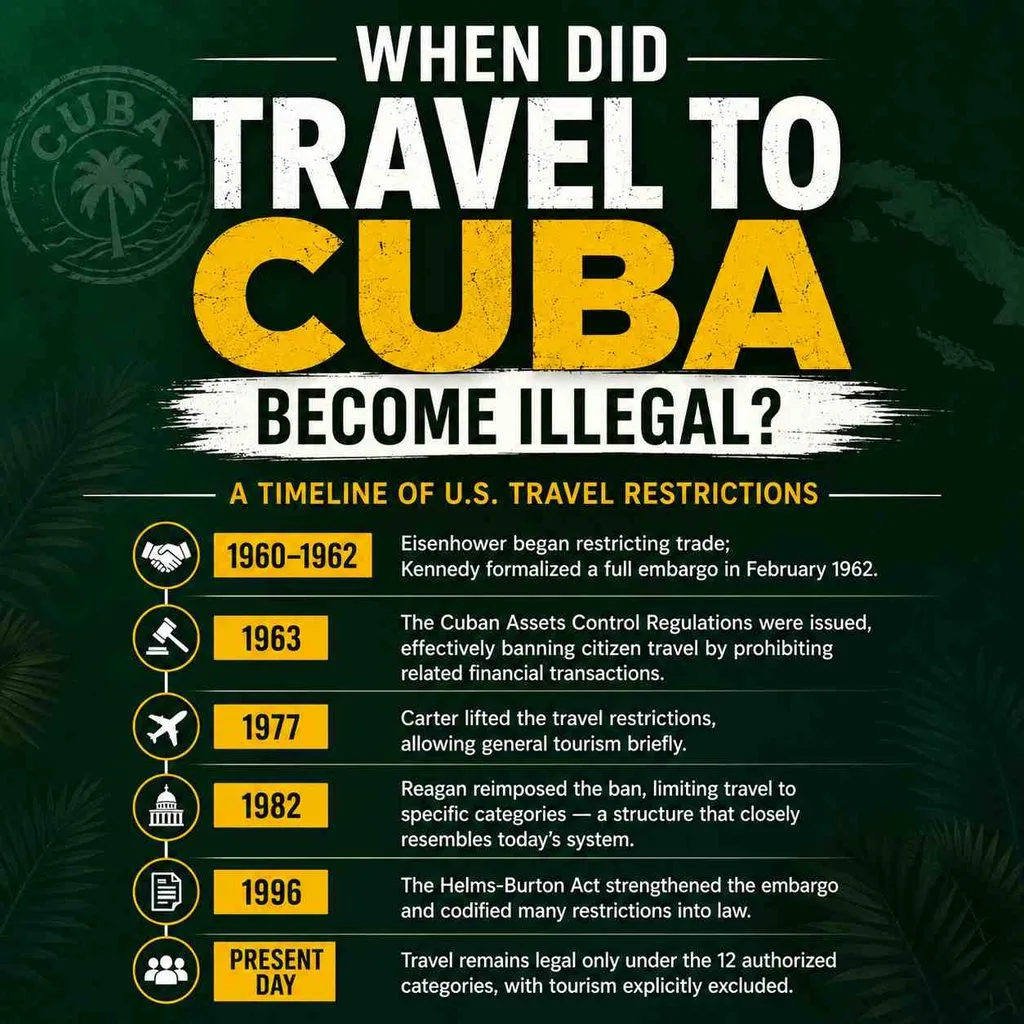
- 1960–1962: Eisenhower began restricting trade; Kennedy formalized a full embargo in February 1962.
- 1963: The Cuban Assets Control Regulations were issued, effectively banning citizen travel by prohibiting related financial transactions.
- 1977: Carter lifted the travel restrictions, allowing general tourism briefly.
- 1982: Reagan reimposed the ban, limiting travel to specific categories — a structure that closely resembles today’s system.
- 1996: The Helms-Burton Act strengthened the embargo and codified many restrictions into law.
- Present day: Travel remains legal only under the 12 authorized categories, with tourism explicitly excluded.
This history explains why “can Americans travel to Cuba legally” doesn’t have a simple yes-or-no answer. It depends on the purpose of the trip and which rules are currently in force.
The 12 OFAC-Approved Travel Categories
This is the core of understanding how can Americans travel to Cuba legally today. If your trip fits into one of these categories, you generally qualify for a general license.
The 12 authorized categories are:
- Family visits
- Official business of the U.S. government, foreign governments, and certain international organizations
- Journalistic activity
- Professional research and professional meetings
- Educational activities
- Religious activities
- Public performances, clinics, workshops, athletic competitions, and exhibitions
- Support for the Cuban people
- Humanitarian projects
- Activities of private foundations or research/educational institutes
- Exportation, importation, or transmission of information or informational materials
- Certain authorized export transactions
Support for the Cuban People: The Most Common Category
Most independent American travelers use the “Support for the Cuban People” category. It doesn’t require institutional sponsorship.
It requires a full-time schedule of activities that strengthen contact with ordinary Cubans. Think private homestays (casas particulares) and privately owned restaurants (paladares), while avoiding state-run hotels tied to the Cuban military.
How to Travel to Cuba as a U.S. Citizen in 2026
Here’s a practical outline of the process:
- Choose your qualifying category. Most leisure travelers select “Support for the Cuban People.”
- Book flights and accommodations that align with your category. Avoid properties on the State Department’s Cuba Prohibited Accommodations List.
- Plan a full itinerary of qualifying activities. Save receipts, tour bookings, and a day-by-day record of your interactions with Cuban citizens and private businesses.
- Bring sufficient cash. U.S.-issued credit and debit cards do not work in Cuba.
- Carry proof of non-U.S. medical insurance, typically included in airline tickets originating from the United States.
- Keep your documentation for at least five years, as required under OFAC recordkeeping rules.
Required Travel Documents
- A valid U.S. passport with at least six months of validity remaining
- A Cuban tourist card or visa, obtainable through your airline or a Cuban visa service
- Proof of non-U.S. medical insurance
- Return or onward flight information
Planning a trip step by step like this is easier when you’ve got a reliable checklist format to follow — our California Local Guides collection uses the same practical, no-fluff approach for other destinations.
Is It Safe to Travel to Cuba Right Now From the USA?
Safety is a separate question from legality. As of the latest U.S. Department of State travel advisory, Cuba is rated a Level 2 destination, meaning travelers should exercise increased caution.
Key safety concerns include:
- Rising petty and violent crime, particularly in tourist areas like Habana Vieja and Varadero
- Frequent, prolonged power outages, especially outside Havana
- Limited emergency medical infrastructure and unreliable ambulance services
- Scarcity of medications and basic pharmaceutical supplies
- Unregulated tourism infrastructure with inconsistent safety standards
Enroll in the Smart Traveler Enrollment Program (STEP). Purchase comprehensive travel insurance with medical evacuation coverage. Stay informed of local conditions throughout your trip.
Money and Currency in Cuba
Financial planning is one of the most overlooked parts of a Cuba trip.
- U.S. credit and debit cards do not function anywhere in Cuba.
- Bring cash — U.S. dollars or euros — to exchange for Cuban Pesos (CUP) at official CADECA exchange houses or banks.
- Cash amounts over $5,000 must be declared upon entry.
- Exchange or spend remaining CUP before departure, since it cannot be converted outside Cuba.
- OFAC places no cap on remittances sent to family members, though certain government officials are excluded from receiving them.
Can Americans Travel to Cuba From Mexico or a Third Country?
Some travelers ask whether flying through Mexico, Canada, or another country changes the requirements. It does not.
U.S. jurisdiction applies to any person subject to U.S. law, regardless of where their trip to Cuba originates. Booking a flight from Cancún or Toronto doesn’t exempt a U.S. citizen from qualifying under one of the 12 categories. The same rules apply whether you fly directly from Miami or connect through a third country.
Things to Do in Cuba Beyond Havana
Once your trip qualifies under an authorized category, Cuba offers a rich list of experiences that also satisfy “Support for the Cuban People” activities.

- Old Havana (Habana Vieja): UNESCO-listed colonial architecture, live music, and classic cars
- Viñales Valley: Limestone hills, tobacco farms, and rural homestays
- Trinidad: Cobblestone streets and a well-preserved colonial town center
- Cuba’s natural hot springs: Destinations like San Diego de los Baños in Pinar del Río are known for their mineral-rich waters, and make for a relaxing detour that also supports local, privately run guesthouses
If soaking in geothermal waters is part of your travel plans, it’s worth browsing our own hot springs destination for more soaking spots worth adding to your bucket list.
For more destination breakdowns like this one, our destinations page covers everything from national parks to coastal getaways.
How Cuba Compares to Other Restricted Destinations
Cuba isn’t the only country where U.S. travel involves legal complexity, though the reasons differ by destination.
- Can Americans travel to Russia? Legal, but discouraged by a State Department advisory citing detention risk.
- Can Americans travel to North Korea? U.S. passports generally aren’t valid there without a special validation.
- Can Americans travel to China? Yes, though the State Department advises caution regarding exit bans.
- Can Americans travel to Venezuela? Legal but strongly discouraged due to wrongful detention risks.
- Can Americans travel to Haiti? Legal, though currently under a high-risk advisory for civil unrest.
- Can Americans travel to Colombia? Yes, with no category restrictions at all.
Cuba’s situation is unique. The restriction is rooted in economic sanctions law rather than a blanket safety advisory, which is why the licensing-category system exists in the first place.
Final Thoughts
So, can Americans travel to Cuba? Yes as long as the trip fits within one of the 12 federally authorized categories, with “Support for the Cuban People” being the most accessible option for independent travelers.
Legal compliance, financial preparation, and awareness of current safety conditions are all essential before booking. With the right planning, a Cuba trip can be both lawful and genuinely rewarding from the streets of Havana to the quiet mineral hot springs tucked into its countryside.
For the official and most current licensing guidance, check the Treasury Department’s Cuba Sanctions page before finalizing your travel plans.
Frequently Asked Questions
Can Americans travel to Cuba as tourists?
No. Pure tourism is prohibited. Travel must fall under one of the 12 OFAC-authorized categories, such as “Support for the Cuban People.”
Can Americans travel to Cuba freely once they choose a category?
Travelers have flexibility in planning their itinerary, but must maintain a full schedule of qualifying activities and keep records to prove compliance.
Can Americans travel to Cuba currently without a specific OFAC license?
Yes, as long as the trip qualifies under a general license category. A specific license is only needed for travel that doesn’t fit any of the 12 categories.
What happens if I book a flight through Google Flights and just visit for leisure?
The booking platform doesn’t matter. Whether you search Google Flights or book directly with an airline, the same OFAC category requirements apply to any U.S. traveler heading to Cuba.